
Your Old Online Article Can Still Get You Sued Today
26 October 2026
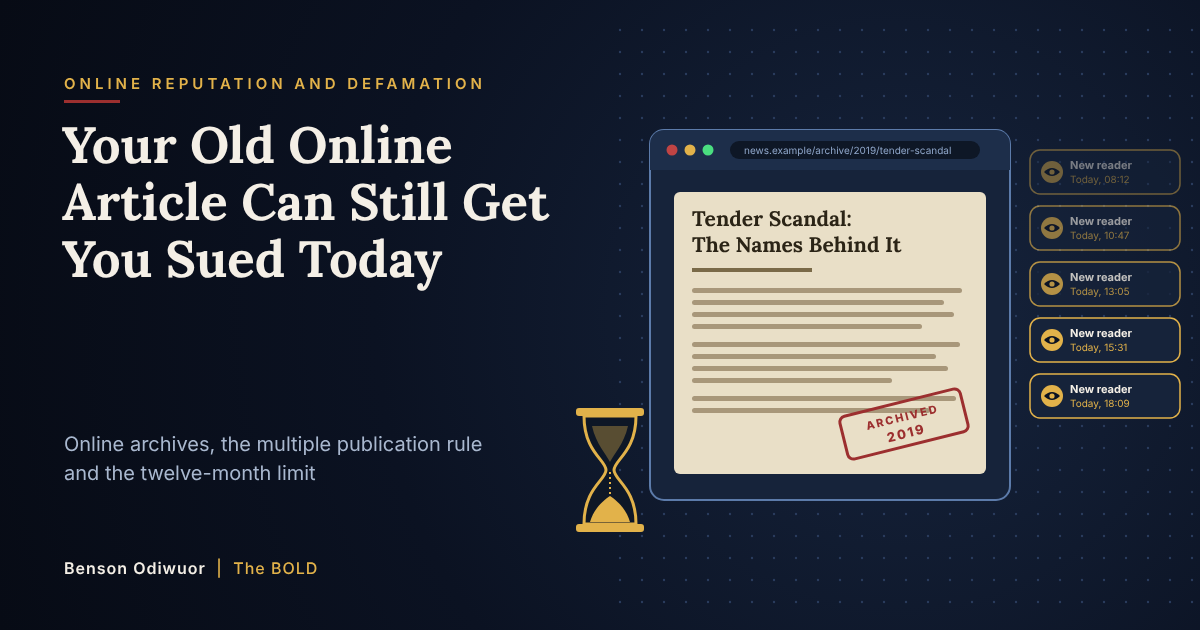
A Kenyan news site published an investigative story in 2019. It named a businessman, alleged that he had been involved in a tender scandal, and has remained in the site's online archive ever since. Seven years later, the businessman files a defamation suit. The publisher's lawyers reach for what looks like a complete answer: the Limitation of Actions Act requires a defamation claim to be brought within twelve months, and the article is seven years old.
The answer may not be complete at all. Under the common law that Kenya inherited, an article that remains online may be published afresh every time someone reads it, and each fresh publication may start a new twelve-month clock. Kenya has not changed that rule, and no Kenyan appellate court has yet decided how it applies to online archives. For media houses, bloggers and companies with years of online content, that uncertainty is a live risk.
The twelve-month limit
The starting point is clear. An action for libel or slander may not be brought after the end of twelve months from the date on which the cause of action accrued.1 The short period reflects the view that a person whose reputation has been damaged should act quickly, and that publishers should not live indefinitely under the threat of litigation.
The difficulty lies in the words ‘the date on which the cause of action accrued’. In defamation, the cause of action accrues on publication. The question is therefore what counts as a publication when an article sits permanently on a website.
The multiple publication rule
The traditional common law answer is that every communication of defamatory material to a third party is a separate publication and a separate cause of action. The rule is traced to Duke of Brunswick v Harmer, decided in 1849. The Duke's servant bought a back issue of a newspaper seventeen years after it was first published, and the court held that the sale was a fresh publication on which the Duke could sue, even though a claim based on the original publication would long since have been time-barred.2
More than a century and a half later, the English Court of Appeal applied the same rule to the internet. In Loutchansky v Times Newspapers Ltd, it held that each time an article in a newspaper's online archive was accessed, it was published afresh, and it declined to adopt the single publication rule used in the United States.3 The High Court of Australia reasoned in the same way in Dow Jones & Co Inc v Gutnick, holding that internet defamation is published where and when the material is downloaded and read.4
Applied to a Kenyan archive, the rule produces a striking result. The 2019 article may be time-barred as to its original publication, but every download by a reader in the last twelve months is arguably a new publication, and the businessman may sue on those.
How other jurisdictions have responded
Many jurisdictions have found the multiple publication rule unworkable for online content, and several have replaced it.
The United States adopted the single publication rule long before the internet, and its courts have applied it online. In Firth v State of New York, the New York Court of Appeals held that a report posted on a government website was published once, when it was first posted, so that the limitation period ran from that date and did not restart with each visit to the page.5
England abolished the multiple publication rule by statute. The Defamation Act 2013 provides that where a person publishes a statement and later publishes the same or substantially the same statement, the limitation period for any claim in respect of the later publication runs from the date of the first publication. That protection does not apply where the later publication is made in a materially different manner.6 New South Wales introduced a similar single publication rule with effect from 1 July 2021, so that the limitation period for later publications of substantially the same matter by the same publisher runs from the date of first publication.7
Before England changed its law, the European Court of Human Rights considered whether the Loutchansky rule violated the right to freedom of expression. In Times Newspapers Ltd v United Kingdom, the Court found no violation on the facts, emphasising the valuable role of press archives and accepting that requiring a newspaper to attach a notice to an archived article once it knew of a libel claim was not a disproportionate interference. The Court cautioned, however, that defamation proceedings brought after a significant lapse of time may, in the absence of exceptional circumstances, amount to a disproportionate interference with press freedom.8
The position in Kenya
Kenya has no statutory single publication rule, and no reported Kenyan appellate decision has decided whether continued availability in an online archive gives rise to fresh causes of action. On the common law as it stands, a claimant has a respectable argument that it does.
That argument is not without limits. A claimant must prove publication, and in the case of an archived article that means proving that someone other than the claimant actually accessed it within the twelve months before the claim was filed. Publication to the claimant's own lawyers or associates, made in order to manufacture a claim, is unlikely to impress a court. The English Court of Appeal in Jameel v Dow Jones & Co Inc struck out a claim as an abuse of process where only five people had accessed the article in England, three of them in the claimant's own camp, holding that no real and substantial tort had been committed.9
A Kenyan court may also be invited to read the limitation provision in light of the Constitution, which protects freedom of expression and the freedom and independence of the media.10 A publisher can argue, drawing on the European Court's caution about stale claims, that exposing a decade of archives to endless litigation would chill legitimate journalism. A claimant can answer that the publisher remains free to correct, annotate or remove material it can no longer stand behind. Until a Kenyan appellate court decides the point, both arguments remain open.
What this means for publishers
For media houses, bloggers and corporate communications teams, the practical consequence is that an online archive is a continuing source of potential liability. Prudent publishers should respond promptly to complaints about archived content, consider attaching a notice to an article once a complaint has been made, correct material that is shown to be wrong, and keep records of when complaints were received and how they were handled. Each of those steps reduces both the risk of a claim and the damages that might follow one.
Publishers should also be aware that republishing old material in a new form, such as resharing an archived story on social media or including it in a new compilation, is likely to be treated as a fresh publication in any event, and would fall outside even a statutory single publication rule of the kind adopted in England.
What this means for claimants
For a person defamed by an article that has been online for years, the twelve-month limit is not necessarily the end of the matter. The claimant will need evidence of recent access by real readers, and should act quickly once that evidence is available, because each publication carries its own twelve-month limit. A demand that the publisher correct or remove the material may also achieve more, and more quickly, than litigation.
On the internet, yesterday's story never quite becomes history. Until Kenya decides when an online publication ends, it may continue to be published every day that someone reads it.
Benson Odiwuor is a Nairobi-based dispute resolution lawyer and researcher in internet jurisdiction, who handles dispute resolution in cross-border digital, data protection and online reputation matters. He is also the editor of The BOLD, a legal newsletter focusing on dispute strategies and legal developments in the regulated industries of Kenya. Subscribe to The BOLD here.
For inquiries, contact the author at info@bensonodiwuor.com.
References
- Limitation of Actions Act (Cap 22), s 4(2). ↩
- Duke of Brunswick v Harmer (1849) 14 QB 185. ↩
- Loutchansky v Times Newspapers Ltd (Nos 2–5) [2001] EWCA Civ 1805, [2002] QB 783. ↩
- Dow Jones & Co Inc v Gutnick [2002] HCA 56, (2002) 210 CLR 575. ↩
- Firth v State of New York 98 NY 2d 365 (2002). ↩
- Defamation Act 2013, s 8. ↩
- Limitation Act 1969 (NSW), s 14C. ↩
- Times Newspapers Ltd (Nos 1 and 2) v United Kingdom App nos 3002/03 and 23676/03, [2009] EMLR 14 (ECtHR, 10 March 2009). ↩
- Jameel (Yousef) v Dow Jones & Co Inc [2005] EWCA Civ 75, [2005] QB 946. ↩
- Constitution of Kenya 2010, arts 33 and 34. ↩