
Why Kenyan PPPs End Up in Court and How to Keep Them Out
18 October 2026
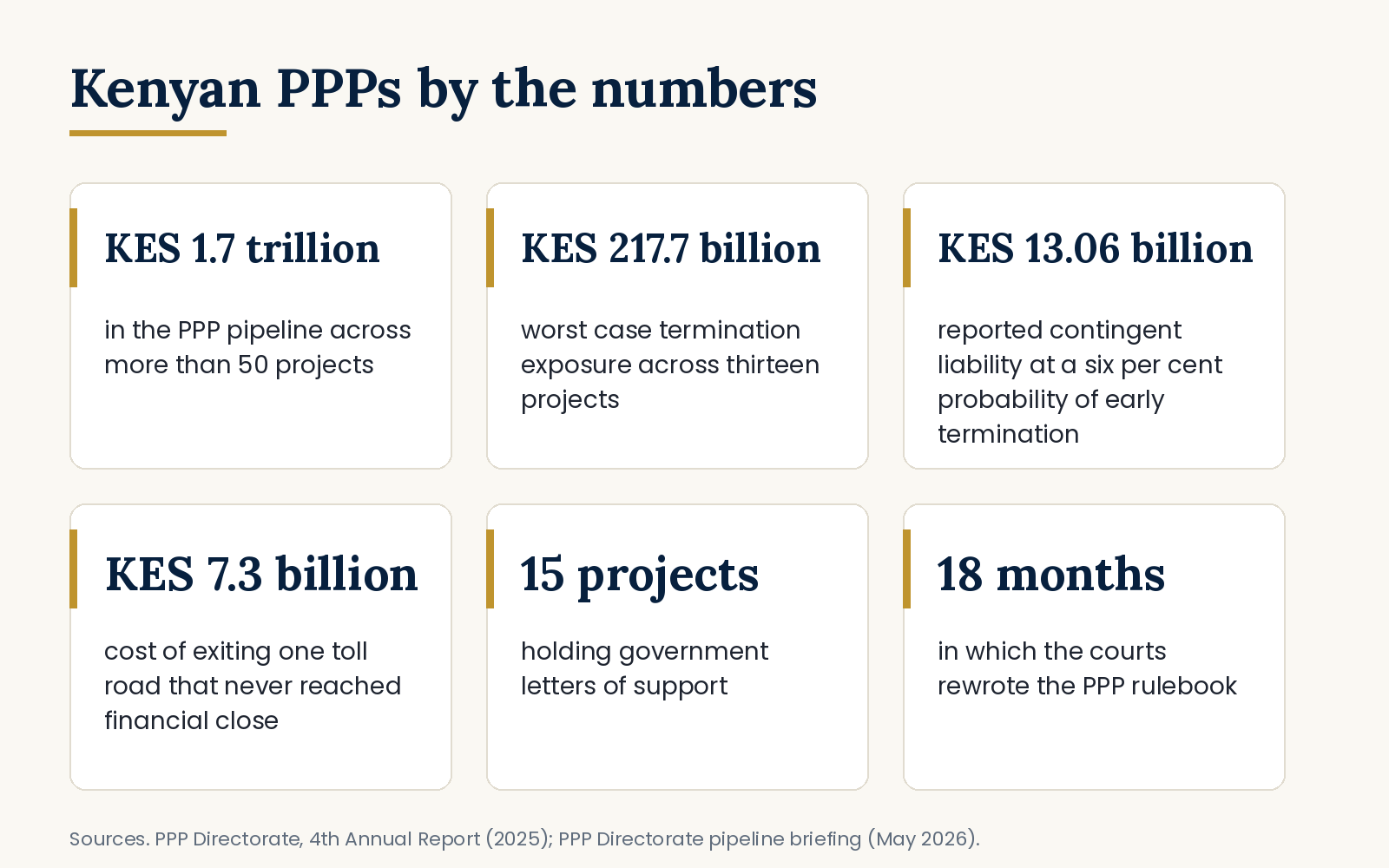
Kenya is relying on private capital as never before. The PPP pipeline now holds over 50 projects worth about KES 1.7 trillion, across transport, energy, water, health and digital infrastructure. The Mombasa and Lamu port concessions have moved to procurement, and in November Nairobi hosts the 16th Africa PPP Summit.
The ambition comes with a price. The Public Private Partnerships Directorate reports a worst case termination exposure of KES 217.7 billion across thirteen projects, which it reduces to a reported contingent liability of KES 13.06 billion by applying a six per cent probability of early termination. Letters of support have been issued to fifteen projects. Just one toll road that never reached financial close cost about KES 7.3 billion to exit. The Adani airport and transmission proposals, the latter valued at about KES 95.68 billion over 30 years, were halted by the courts and then cancelled.
In Kenya, the law on how those bets are made has changed more in the last 18 months than in the decade before. That is why I wrote Why Kenyan PPPs End Up in Court and How to Keep Them Out, which you can read in full here here.
What has changed, and why this paper is needed now
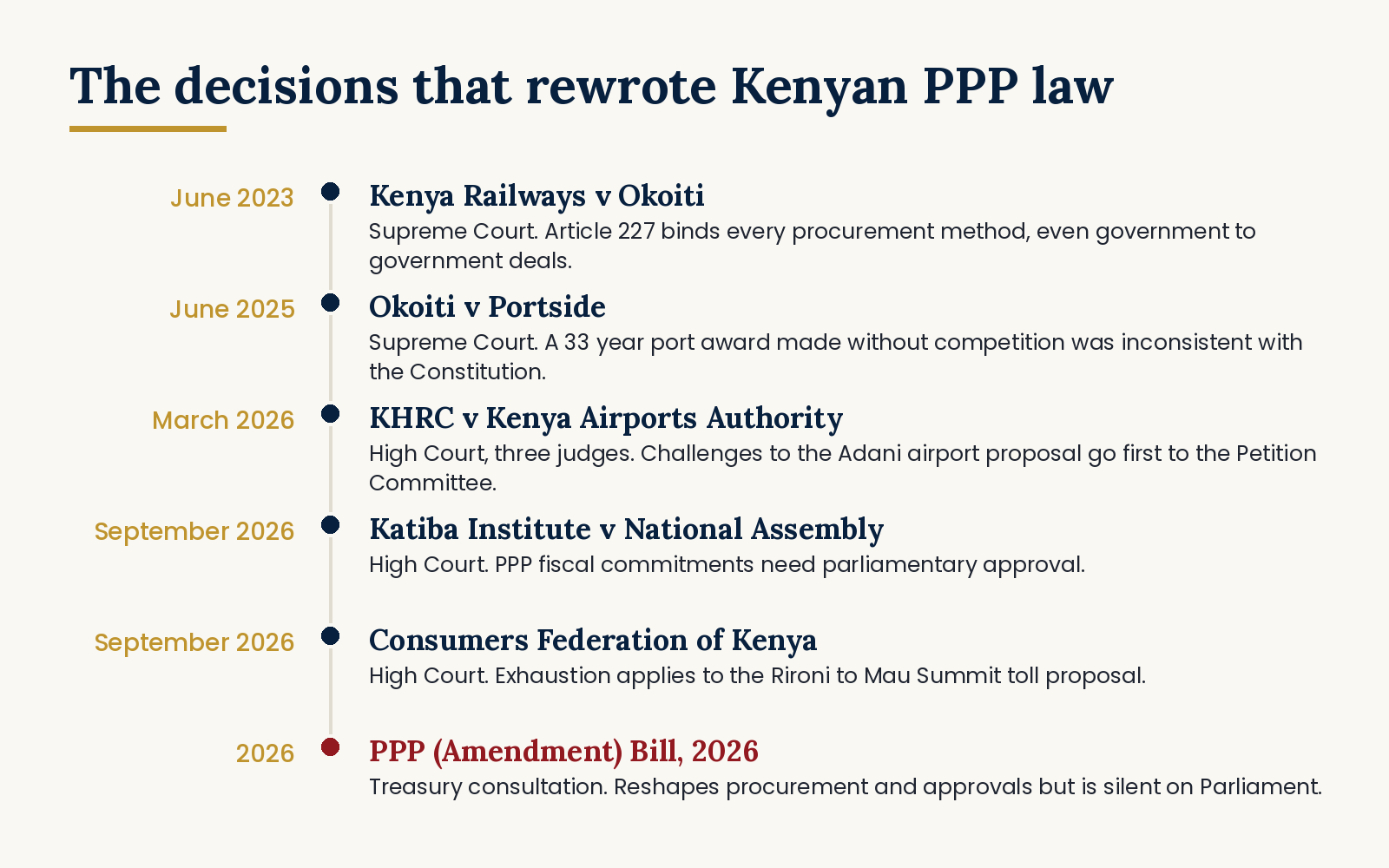
Disputes over public private partnerships (PPPs) in Kenya are no longer hypothetical. Within fifteen months the Supreme Court held the award of a 33 year port license inconsistent with the Constitution of Kenya for want of competition, a three judge bench of the High Court sent a challenge to the Adani airport proposal back to the statutory Petition Committee, and the High Court declared parts of the Public Private Partnerships Act, 2021 unconstitutional for keeping Parliament out of fiscal commitments. In the same period the State incurred termination costs of several billion shillings on a toll road concession that never reached financial close, and it continues to carry a reported worst case termination exposure of KES 217.7 billion.
One week after that constitutional ruling, the High Court applied the same exhaustion rule to the Rironi to Mau Summit toll proposal, at a stage when the project was still out for consultation. Meanwhile the National Treasury has released the Public Private Partnerships (Amendment) Bill, 2026 for public participation. Governments, investors, lenders and advisers need one place where all of this is set out clearly and accurately. Until now there has not been one.
The argument of the paper
This paper argues that most PPP disputes in Kenya are predictable, because they gather at a small number of fault lines in the legal design and in the way transactions are run. It begins with the statutory definition of a PPP and the distinction between PPPs and traditional public procurement, a distinction on which much of the litigation has turned. It then maps every player in the PPP chain, traces the legal infrastructure from the early concessions to the 2021 Act and the 2026 reform proposals, analyses the decided cases, and identifies the blind spots that turn ordinary friction into litigation. Each decided case is discussed in turn, with its facts, holdings and relationship to earlier and later decisions, and the cases are then summarised in a table. The paper then sets out the dispute resolution tools available under Kenyan law and proposes a dispute avoidance framework addressed to each player in turn, with a relational architecture for project agreements.
The paper advances five propositions.
- Kenyan PPP disputes cluster at identifiable fault lines. The principal ones are the choice and justification of the procurement method, the treatment of privately initiated proposals, disclosure and public participation, fiscal authority for government support and payment obligations, land and affected persons, tariff setting for projects in which users pay, and the exit terms when a project is cancelled before or after signature.
- Each player in the PPP chain is exposed to a different subset of those fault lines, and much avoidable conflict arises because a player cannot see a risk that sits with another player until it crystallises. This paper calls those points blind spots.
- The 2021 Act removed some blind spots of the 2013 regime, particularly the slow Cabinet route and the narrow Petition Committee, but created new ones. It widened discretion in the choice of procurement method, it left the relationship between the Act and the fiscal powers of Parliament unresolved until the High Court resolved it in September 2026, and it contains drafting defects that will themselves generate litigation.
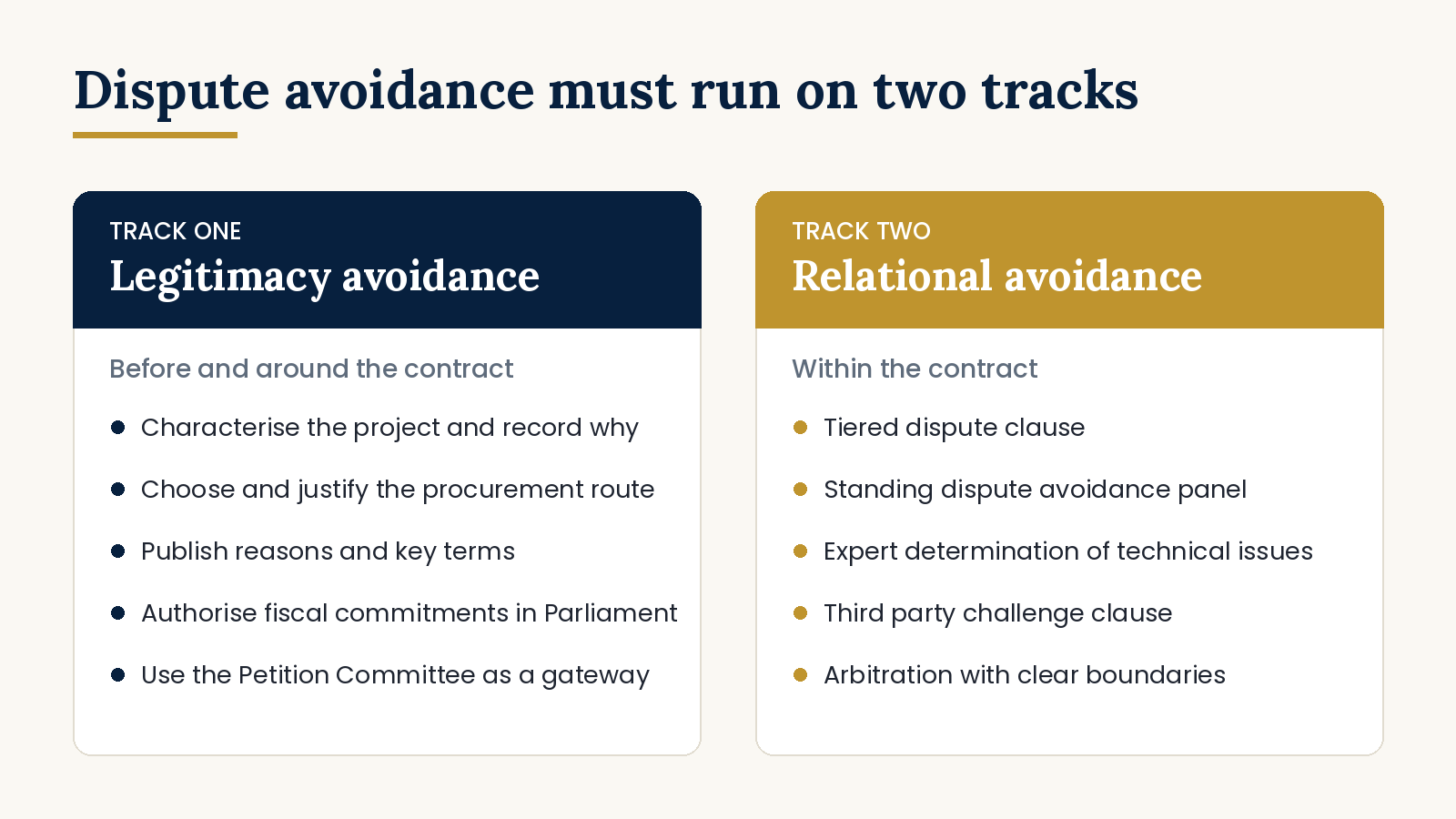
- Dispute avoidance in Kenya must therefore run on two tracks. The first is legitimacy avoidance, which addresses the public law challenges that arise before and around the contract. The second is relational avoidance, which addresses the commercial disputes that arise within it. Most guidance written for Kenyan practitioners addresses only the second track.
- The distinction between a PPP and traditional procurement is a fault line in its own right. Because Article 227 of the Constitution of Kenya sets standards rather than prescribing a single statute or method, the decisive questions in litigation are which framework governs a project and whether that framework delivered fairness, equity, transparency, competitiveness and cost effectiveness on the record. Many disputes would be avoided if the characterisation of a project, and the reasons for it, were settled and published before procurement began.
The key findings
- The dominant Kenyan PPP dispute is a legitimacy dispute about how a project was chosen, procured, disclosed or approved. It is usually brought by a third party who is not a party to the contract, and it is framed in constitutional terms.
- A PPP is a distinct legal form and not a species of ordinary procurement. The courts have rejected the argument that Article 227 of the Constitution of Kenya requires every public contract to be procured under the Public Procurement and Asset Disposal Act, holding that Article 227 sets standards rather than a single method, but they insist that the correct framework be identified at the outset and that it deliver those standards.
- Every procurement method, including privately initiated proposals, direct procurement, specially permitted procedures and government to government arrangements, must satisfy the constitutional minimum in Article 227 of the Constitution on a contemporaneous record.
- Since 17 September 2026, a PPP that creates expenditure, borrowing, guarantees, public debt or other public liability for the national government requires parliamentary authority for that commitment. The declaration is suspended until March 2027, and the matter returns to court on 11 May 2027.
- Challenges to decisions of a contracting authority, the PPP Directorate or the PPP Committee must now go first to the Petition Committee under section 75 of the 2021 Act, unless the High Court grants an exemption on a formal application under section 9(4) of the Fair Administrative Action Act.
- Cancelling a contested project does not end the litigation about it, and it carries its own price. The State has incurred termination costs recorded at about KES 7.3 billion on one toll road concession that never reached financial close.
- The PPP Directorate reports worst case termination exposure of KES 217.7 billion across thirteen projects, reduced to a reported contingent liability of KES 13.06 billion by applying a six per cent probability of early termination.
- The 2021 Act contains drafting defects, including a seven-day petition period that runs from decisions that are sometimes unpublished, a definition of PPP that excludes arrangements in which no facility is transferred, and cross references that point to the wrong provisions.
- The Public Private Partnerships (Amendment) Bill, 2026 would exclude the PPADA from every PPP, delete the thirty year ceiling on PPP arrangements, reduce the review role of the PPP Directorate, move the approval of county PPPs from county assemblies to county executive committees and extend the period for petitions to the Petition Committee to fourteen days. It contains no procedure for the parliamentary approval of fiscal commitments that Katiba Institute requires.
- The principal blind spots are the absence of a single reasoned public decision for each project, an unsolicited proposal pathway without a competitive challenge, disclosure that comes after signature, fiscal commitments made without parliamentary authority, a maze of forums, and exit terms that are left unpriced.
- PPP dispute avoidance in Kenya must run on two tracks, legitimacy avoidance before and around the contract and relational avoidance within it. This paper proposes a gate-based legitimacy protocol, a relational architecture for project agreements, a checklist for each player, and twenty recommendations for the 2026 amendments.
What you will find inside
The paper covers the field from start to finish.
- What the law means by a PPP, and how a PPP differs from traditional procurement on financing, risk, duration, payment, approvals and forum.
- The legal history, from the 1989 airport concession through the Constitution of 2010, the PPP Acts of 2013 and 2021 and the specially permitted procurement detour of 2017.
- The transition from the 2013 regime to the 2021 regime, and the drafting defects that will generate litigation.
- A map of every player, from contracting authorities, the PPP Committee and Directorate, the Treasury, Parliament and counties, to sponsors, lenders, operators, users, communities, workers, civil society and the arbiters who decide their disputes.
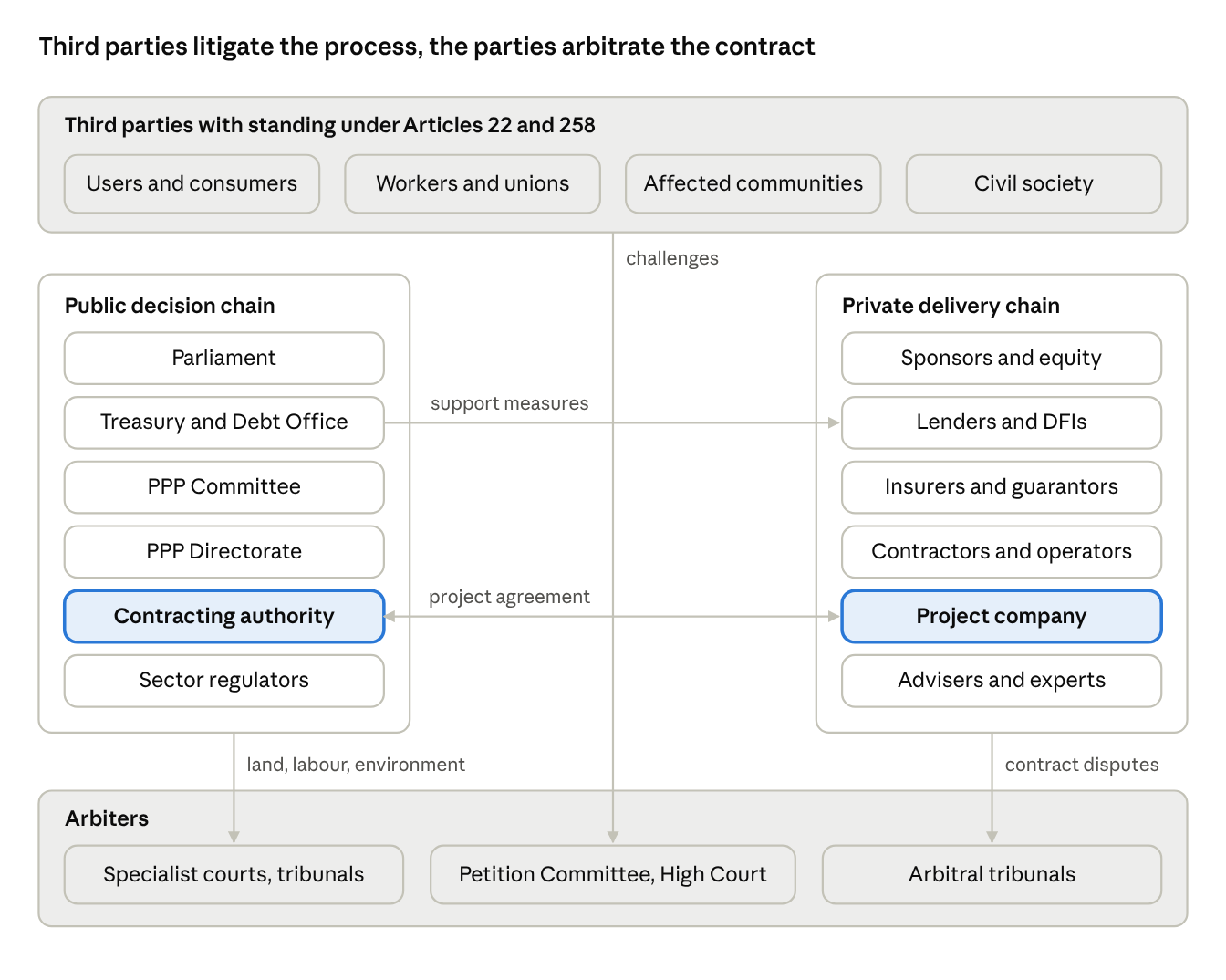
The players in a Kenyan PPP and the forums to which their disputes travel
- Every decided PPP case, discussed individually, from World Duty Free at ICSID to Portside, Katiba Institute, Consumers Federation of Kenya and the Lake Turkana land litigation, together with Petition Committee decisions that are rarely cited, including one that cancelled a road award after finding the evaluation criteria had been twisted and another that ordered the roads authority to pay about KES 113 million in costs.
- Eighteen blind spots in the framework, from the characterisation gap to a Petition Committee whose capacity has not been shown in public even as the courts insist on it.
- Comparative lessons from Lesotho, the United Kingdom, Tanzania and the South African toll roads.
- A clause by clause reading of the 2026 Bill, showing what it fixes, what it leaves untouched and the new problems it would create.
- A practical framework, with a gate by gate legitimacy protocol, a relational architecture for project agreements, a checklist for each player and twenty recommendations.
Why it matters beyond Kenya
Governments and investors across Africa are asking the same questions Kenya is now answering in court, about unsolicited proposals, contingent liabilities, legislative approval and public accountability. Kenya offers a live case study of what happens when constitutional accountability meets project finance, and of how both can be managed.
Who will find value in it
Governments, PPP units and contracting authorities looking for a defensible way to approve and procure projects. Development finance institutions, lenders and investors assessing legal and political risk. Sponsors, contractors, operators and transaction advisers structuring bids, private proposals and project agreements. Advocates, arbitrators and in house counsel who need a single, fully referenced account of Kenyan PPP case law. Parliamentarians, county assemblies and treasury officials working out what the courts now require of them. Civil society, journalists, researchers and students who want to understand where PPP accountability now stands.
In Kenya, the cheapest PPP dispute is the one that was answered in public before anyone thought to ask it in court.
Get the paper here.