
Accepting M-Pesa Can Get Your Brand Sued in Kenya
22 October 2026
A fashion label based in Dubai sells online to customers around the world. It has no shop, office or employee in Kenya, but its website lists prices in Kenya shillings, offers delivery to Nairobi within five days and accepts payment by M-Pesa. When a Kenyan company claims that the label’s products infringe its registered trademark, the label’s first instinct is to say that it does not trade in Kenya and that any dispute belongs elsewhere.
That instinct may be wrong. Courts in a growing number of jurisdictions now ask not where a business is located, but whom its website is aimed at. Every choice of design that welcomes a particular market, from the currency on the checkout page to the payment methods it accepts, becomes evidence that the business has chosen to trade there. For brands selling online into Kenya, the design of a website is now a jurisdictional decision.
Why accessibility alone is not enough
Almost every website can be viewed from Kenya. If accessibility alone were enough, every online business in the world would be exposed to suit in every country, which no court has been prepared to accept. The early American approach tried to solve the problem by measuring how interactive a website was. In Zippo Manufacturing Co v Zippo Dot Com, Inc, a federal court placed websites on a sliding scale, from passive sites that merely post information to sites through which the defendant clearly does business with residents of the forum.1 That test was designed for the internet of the 1990s. Today almost every commercial website is interactive, and the sliding scale tells a court very little.
Therefore, courts have presently moved to a different question: was the website targeted at the forum?
The targeting test
The Court of Justice of the European Union set out the most influential version of that test in Pammer. It held that the mere accessibility of the website of a trader in a member state is not enough to show that the trader directs its activities there. Instead, the court must look for evidence that the trader envisaged doing business with consumers in that state, such as the international nature of the activity, the use of a language or currency other than that generally used where the trader is established, the provision of telephone numbers with an international code, and the use of a top-level domain name other than that of the trader’s own state.2 The same Court later applied a similar approach to offers for sale on an online marketplace in L’Oréal SA v eBay International AG, holding that it is for national courts to assess whether such offers are targeted at consumers in their territory.3
The UK Supreme Court refined the test in Lifestyle Equities CV v Amazon UK Services Ltd. The question, it held, is whether the average consumer in the forum, who is reasonably well informed and observant, would consider the website to be directed at him or her. Mere accessibility of an overseas website is not enough, but the court must look at the website as the consumer actually experiences it. Amazon’s US website displayed a message offering delivery to the United Kingdom whenever it was visited from a UK address, quoted prices and delivery charges for the United Kingdom, and allowed payment in sterling. Those features led the Court to conclude that the US website was targeted at UK consumers, even though Amazon also operated a separate UK site.4
The Delhi High Court reached a comparable position in Banyan Tree Holding (P) Ltd v A Murali Krishna Reddy. It held that the accessibility of a website in Delhi did not by itself confer jurisdiction on the Delhi courts, and that the plaintiff had to show that the defendant purposefully availed itself of the forum by specifically targeting it with a view to commercial transactions.5 The court also cautioned that a single transaction engineered by the plaintiff to manufacture jurisdiction would not suffice.
Where Kenya stands
No Kenyan court has yet articulated a targeting test for websites. The question is nonetheless already before the Kenyan courts in a different form.
In the litigation brought by content moderators against Meta, the claimants argued that a foreign company can operate fully in Kenya without a physical office, and relied on the decision of the Full Federal Court of Australia in Valve Corporation v Australian Competition and Consumer Commission, which held that a foreign digital distributor with substantial online sales to Australian customers carried on business in Australia.6 The Court of Appeal did not decide the point. It held instead that whether Meta engaged in virtual business, and whether that business was available in Kenya, were questions of fact that could only be resolved at a full hearing.7
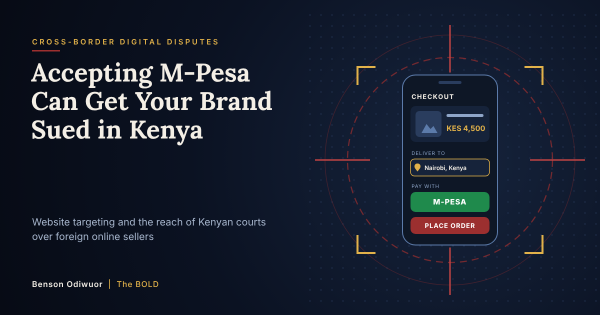
That holding matters for every online brand. If a foreign company’s digital presence in Kenya is a question of fact, then the features of its website are evidence, and the court will examine them closely. A checkout page priced in shillings, a delivery option to Kenyan towns and a payment button for M-Pesa are exactly the kind of features that, under the Pammer and Lifestyle Equities approach, would point towards Kenya as a targeted market.
Kenyan legislation already treats digital engagement with Kenyan users as a meaningful connection. The Data Protection Act applies to data controllers and processors that are not established in Kenya but process the personal data of data subjects located in Kenya,8 and since December 2024 the Income Tax Act has taxed the significant economic presence of non-resident digital service providers whose users are located in Kenya.9 Neither statute governs the jurisdiction of the civil courts, but a business that is regulated and taxed in Kenya on the strength of its Kenyan users will find it difficult to persuade a Kenyan judge that it has no connection with Kenya at all.
How a targeted website opens the door to a Kenyan court
Targeting matters in two ways. First, it may supply the substantive wrong. Trademark rights are territorial, and a registered proprietor in Kenya is protected against the use of the mark in the course of trade in Kenya.10 A foreign website that offers infringing goods to Kenyan consumers may therefore be using the mark in Kenya, even if the seller never sets foot in the country.
Secondly, it supplies the procedural link that allows a foreign seller to be brought before a Kenyan court. A claimant who wishes to serve a defendant outside Kenya must obtain the court’s leave, and the recognised grounds include that the suit is founded on a tort committed in Kenya and that an injunction is sought as to anything to be done in Kenya.11 Evidence that a foreign website targets Kenyan consumers is precisely what a claimant will put before the court to show that the infringement occurred in Kenya and that an injunction is needed here.
What this means for brands
For foreign brands, the practical lesson is that every feature that welcomes Kenyan customers also increases the risk of being sued in Kenya. These may include:
- Pricing in shillings,
- Accepting M-Pesa payment
- Offering delivery to Kenyan addresses
- Advertising to Kenyan users
- Using Swahili, or
- Operating a domain ending in .co.ke
All these are likely to be treated as evidence of targeting. None of these choices is wrong, but each should be made with the knowledge that the business may be expected to answer for its conduct in a Kenyan court, and that its Kenyan sales may be subject to Kenyan trademark rights it has never checked.
For Kenyan brand owners, the same features are the evidence they need. A careful record of the infringing website as a Kenyan consumer sees it, including screenshots of prices, delivery options and payment methods captured from a Kenyan location, and evidence of genuine sales to Kenyan customers, will form the foundation of any application for leave to serve a foreign seller. Following the warning in Banyan Tree, a single purchase arranged by the brand owner’s own investigator should not be relied on in isolation.
The internet has not removed borders from commerce. It has moved them into the design of the checkout page.
Benson Odiwuor is a Nairobi-based dispute resolution lawyer and researcher in internet jurisdiction, who handles dispute resolution in cross-border digital, data protection and online reputation matters. He is also the editor of The BOLD, a legal newsletter focusing on dispute strategies and legal developments in the regulated industries of Kenya. Subscribe to The BOLD here.
For inquiries, contact the author at insights@bensonodiwuor.com.
References
- Zippo Manufacturing Co v Zippo Dot Com, Inc 952 F Supp 1119 (WD Pa 1997). ↩
- Joined Cases C-585/08 and C-144/09 Peter Pammer v Reederei Karl Schlüter GmbH & Co KG and Hotel Alpenhof GesmbH v Oliver Heller EU:C:2010:740. ↩
- Case C-324/09 L'Oréal SA v eBay International AG EU:C:2011:474. ↩
- Lifestyle Equities CV v Amazon UK Services Ltd [2024] UKSC 8. ↩
- Banyan Tree Holding (P) Ltd v A Murali Krishna Reddy 2009 SCC OnLine Del 3780, (2010) 42 PTC 361 (Del) (DB). ↩
- Valve Corporation v Australian Competition and Consumer Commission [2017] FCAFC 224. ↩
- Meta Platforms, Inc & 2 others v Motaung & 186 others; Kenya National Human Rights and Equality Commission & 14 others (Interested Parties) (Civil Appeal E232 & E445 of 2023 (Consolidated)) [2024] KECA 1262 (KLR), paras 23 and 49. ↩
- Data Protection Act 2019 (Cap 411C), s 4(b)(ii). ↩
- Tax Laws (Amendment) Act 2024, amending the Income Tax Act (Cap 470) with effect from 27 December 2024. ↩
- Trade Marks Act (Cap 506), s 7. ↩
- Civil Procedure Rules 2010, Order 5 r 21(f)–(g). ↩