
Petrol Dealer Agreements as Franchises in Kenya. Implied Terms, Good Faith and the Operations Manual
2 November 2026
Kenya has no franchise statute, so the contract and the terms the courts imply decide everything. The law answers 3 questions about them. What documents make up the contract? What terms does the law imply? How must each party exercise its discretions? This edition answers each of them from the law and the decided cases.
| KEY POINTS AT A GLANCE Kenya has no franchise statute. A petrol dealer agreement that licenses a brand, imposes a system and charges fees for it operates as a franchise, but its terms are governed by the general law of contract, sale of goods, intellectual property and competition. Because no statute fills the gaps, the terms that the court implies matter a great deal. The High Court held in October 2025 that an oil company that charged a maintenance fee had to maintain the equipment, and that a company that mandated a point of sale system and kept control of it had to keep it reasonably secure. Kenyan law does not recognise a general duty of good faith in commercial contracts, but courts have described unannounced price changes by an oil company as inconsistent with good faith and fair trading. English courts have implied duties of good faith into long term relational contracts, and that reasoning is likely to be urged in Kenya. Operations manuals, standards documents and system rules often bind the dealer by reference and can be changed by the company alone. Whether a change binds the dealer depends on the incorporation clause, the scope of the power to vary and the limits the law places on its exercise. Many dealer relationships run on unsigned documents. A court will find a binding contract from an offer letter and the conduct of the parties, even where the formal licence was never signed. Every franchise dispute in the sector turns on 3 questions. What documents make up the contract? What terms does the law imply? How must each party exercise the discretions the contract gives it? |
I. Introduction
A branded petrol station looks like a franchise. The dealer trades under the name, colours and marks of the oil company, follows its standards and uses its systems, and pays for the privilege through royalties, rents or fees per litre. The company controls supply, prices, equipment and much of the customer experience. Many companies call their agreements dealership licences, marketing licences or operator agreements rather than franchises, but the commercial substance is the same.
In countries that regulate franchising by statute, the law requires disclosure before signing, controls termination and sometimes imposes a duty of fair dealing. Kenya has no such statute. The relationship rests on the agreement and on the general law. That makes the drafting of the agreement, the documents it incorporates and the terms that the courts are prepared to imply decisive.
This edition of The BOLD explains how Kenyan law treats a petrol dealer agreement as a franchise. It describes the elements of a franchise, sets out the general law that governs it, examines the implied terms recognised in the cases, considers whether a duty of good faith applies, and analyses the legal effect of operations manuals. It closes with practical guidance. It takes no position on any matter pending before a court or tribunal.
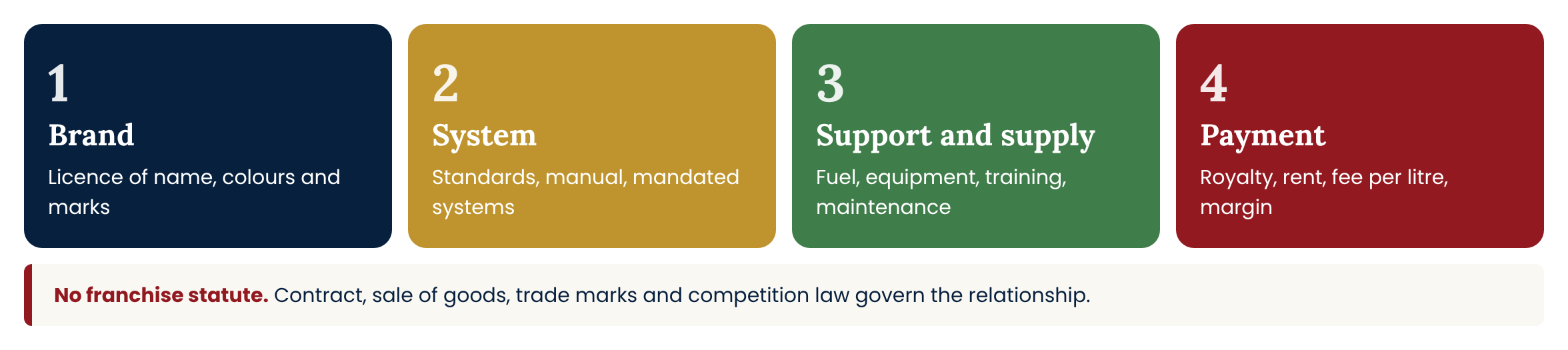
Figure 1. The elements of a petrol station franchise
II. Foundational concepts
2.1 What makes a franchise
A franchise usually has 4 elements. The franchisor licenses its brand. It prescribes a system for running the business. It provides continuing support, training or supply. And the franchisee pays for these rights, whether by an initial fee, royalties or a margin on goods it must buy from the franchisor. A petrol dealer agreement typically has all 4. In Njane the dealer was granted the right to use the equipment, trade name, trade marks and goodwill of the oil company, paid a monthly royalty of KSh 950,000 and a maintenance fee per litre, bought exclusively from the company, and operated a point of sale system that the company mandated and controlled.1 The High Court did not need to label the arrangement, but the Standard reported the case as a franchise dispute.2
2.2 No franchise statute
Kenya has no franchise specific legislation, and franchise relationships rely on the general commercial law.3 There is no mandatory disclosure before signing, no cooling off period, no statutory notice for termination and no statutory compensation on exit. The petroleum regulator has signalled an interest in reviewing dealership, commercial and franchise agreements, but no statute or regulation yet prescribes their content.4
2.3 Contract documents
The relationship is rarely contained in a single document. It may include an offer letter, a dealership or marketing licence, a supply agreement, an equipment loan agreement, a schedule of charges, a brand licence, an operations manual, technical standards, a credit facility and a security document. Each may contain its own provisions on variation, termination and disputes. Identifying which documents form the contract, and which prevails in a conflict, is the first step in any dispute.
III. Legal framework
3.1 Contract law
The Law of Contract Act applies the common law of England relating to contract, as modified by the doctrines of equity and by statute, to Kenya.5 Kenyan courts therefore draw on English authority on the formation and interpretation of contracts and on implied terms. In Njane the High Court applied the objective approach of the United Kingdom Supreme Court in deciding whether the parties had concluded a contract despite the failure to sign the formal licence.6
3.2 Sale of goods
Fuel, lubricants and gas sold to a dealer are goods. Unless validly excluded, the Sale of Goods Act implies conditions that the goods correspond with their description, and in a sale by a seller who deals in goods of that description, that they are of merchantable quality.7 A dealer that receives off specification fuel from its own supplier has a remedy in contract, which matters because the dealer, not only the supplier, may be exposed to regulatory action for selling it.8
3.3 Intellectual property
The brand is protected under the Trade Marks Act, and the dealer uses it under licence.9 The operations manual and system documents may be protected as copyright works and as confidential information. The licence ends when the agreement ends, and continued use after that point may be infringement or passing off.
3.4 Competition law
The Competition Act controls restrictive clauses in franchise agreements, including resale price maintenance and ties on unrelated products.10 The fourth edition in this series examines these controls for petrol stations.
IV. Implied terms
4.1 The test
A court will imply a term into a commercial contract where it is necessary to give the contract business efficacy, where it is so obvious that it goes without saying, where it is capable of clear expression, and where it does not contradict an express term.11 The court does not imply a term merely because it would be reasonable. The question is what the contract, read as a whole against its background, must have meant.
4.2 Terms implied in Njane
Njane is the leading Kenyan example of implied terms in a petrol franchise. The High Court held that because the dealer paid a maintenance fee of KSh 0.23 per litre, the company was under an express and implied obligation to maintain the equipment, and was liable for losses caused by breakdowns and poor maintenance.12 It held that the company, having mandated the Kenserve point of sale system and refused to allow an alternative, owed an implied duty to ensure that the system was reasonably secure. It found that the company retained control of the system so that it could monitor the business of the dealer, and that the refusal to permit alternatives contributed to the losses from manipulation of the system.13
The reasoning reflects a principle that is likely to apply widely in petrol franchises. Where the franchisor charges for a service, or requires the franchisee to use a system that the franchisor controls, the franchisor takes on a corresponding duty to provide that service or system to a reasonable standard.
4.3 Duty to supply
An exclusive purchase obligation leaves the dealer dependent on the company for stock. In Njane the court found that the company had a duty to supply and had breached it through frequent stock outs and short deliveries, and that the fact that some cheques had bounced did not excuse supply failures at other times, particularly because the company held a bank guarantee as security.14 A company that ties a dealer and then fails to supply undermines the foundation of the bargain.
4.4 Limits on implication
The limits are equally instructive. The dealer in Njane claimed for interest on late remittance of card receipts. The court found unexplained delays but rejected the claim because no agreed timeline was proved.15 It also rejected a claim that the company had breached the contract by cutting pump prices without 30 days notice, because the offer letter contained no such term.16 The court will not write a better bargain for a dealer than the one it made.
Table 1. Claims in Njane and how the court treated them
| Claim | Outcome | Reason |
|---|---|---|
| Lost business value | Allowed. KSh 61,460,012 | Expert valuation preferred |
| Lack of stock | Allowed. KSh 18,736,211.48 | Duty to supply breached |
| Manipulation of point of sale system | Allowed | Implied duty to keep a mandated system secure |
| Short landing | Allowed. KSh 2,302,575.47 | Deliveries below delivery notes billed in full |
| Equipment downtime | Found proved | Maintenance fee implied a duty to maintain |
| Price changes without notice | Dismissed | No express notice term |
| Interest on late card remittances | Dismissed | No agreed timeline proved |
V. Good faith
5.1 Kenyan position
Kenyan contract law has no general doctrine requiring parties to commercial contracts to perform them in good faith. Courts give effect to the bargain the parties made. Njane nonetheless shows that the courts are alert to the fairness of conduct within a long term relationship. The court held that cutting pump prices without notice was not a breach of contract, but it found that the conduct breached good faith and fair trading.17 The observation did not produce a remedy, but it signals that a court may scrutinise how a company exercises its powers.
5.2 English relational contracts
English courts have gone further. In Yam Seng the High Court held that a duty of good faith could be implied into a long term distribution agreement, describing such agreements as relational contracts that require a high degree of communication, cooperation and trust.18 In Bates the High Court held that the contracts between the Post Office and its sub postmasters were relational contracts that contained an implied duty of good faith, which required the Post Office to refrain from conduct that reasonable and honest people would regard as commercially unacceptable.19 The sub postmasters, like petrol dealers, ran outlets under the brand of a powerful counterparty, used its systems and depended on it for their livelihood.
5.3 Prospects in Kenya
A Kenyan court applying the common law of contract may find this reasoning persuasive for long term petrol franchises, particularly where the dealer has made a substantial investment and the company controls the systems and supply on which the dealer depends.20 The facts of Njane, where the company controlled the point of sale system and the court found manipulation of it, resemble the facts that led the English court to imply a duty in Bates.21 Until a Kenyan appellate court decides the point, the argument remains open.
VI. Operations manuals and discretions
6.1 Incorporation
Dealer agreements often require the dealer to comply with an operations manual, technical standards, brand guidelines and policies issued by the company from time to time. These documents bind the dealer only if they are incorporated into the contract. Incorporation requires a clear reference in the signed agreement and reasonable notice of the document. A dealer that has never been given the manual has a strong argument that unusual or onerous provisions in it do not bind it.
6.2 Unilateral variation
The power to issue a manual from time to time is a power to vary the contract. Courts construe such powers according to their terms and do not extend them to fundamental changes that the parties could not have contemplated. A power to update operational procedures does not obviously authorise new fees, a new rent or a new restriction on products. In 2025 the petroleum regulator found that some oil companies were imposing additional unapproved charges on dealers.22 Where such charges are introduced through a manual or a policy rather than a signed variation, their contractual basis may be weak.
6.3 Limits on discretion
Many franchise agreements give the franchisor discretions, such as the power to set prices, approve suppliers, allocate stock or decide whether a breach has occurred. English law implies that a contractual discretion must be exercised honestly, for a proper purpose and not arbitrarily, capriciously or irrationally. That principle forms part of the common law of contract that applies in Kenya.23 It does not require the company to act in the interests of the dealer, but it prevents the company from using a discretion to defeat the purpose of the contract.
6.4 Systems and data
Modern dealer agreements require the use of payment terminals, fleet card systems and automated tank gauges that the company owns and monitors. The company thereby gains real time access to the sales and stock data of the dealer. Njane shows that control of the system brings responsibility for its security.24 It also raises questions about who owns the data and how it may be used, which a well drafted agreement should answer.

Figure 2. When a manual or policy binds the dealer
VII. Formation without signature
Many dealers begin trading on an offer letter while the formal agreement is negotiated, and some never sign it. In Njane the offer letter was expressed to be subject to contract and time bound, and the formal marketing licence was drafted but never signed. The High Court held that the parties had concluded a binding contract on the terms of the offer letter, because for about 2 years they had acted on it as binding.25 The company could not rely on the force majeure clause of the unsigned licence.26
The lesson cuts both ways. A company that lets a dealer trade without a signed agreement may find that the terms it intended to impose do not apply, and that the court will look instead at the offer letter and the conduct of the parties. A dealer may find that the protections it expected from the formal document are also unavailable. In Kileleshwa the trial judge found that the agreement was oral, despite the insistence of the company that a standard written licence had been signed.27
VIII. Open legal questions
8.1 Pre contract disclosure
In the absence of a franchise statute, a dealer has no right to disclosure of the expected volumes, costs or margins of a station before signing. A dealer that was given materially false projections may have a claim in misrepresentation, but the law imposes no general duty to disclose. Whether the petroleum regulator will prescribe disclosure as part of its review of dealer agreements remains to be seen.28
8.2 Good faith
The second question is whether Kenyan courts will imply a duty of good faith into long term petrol franchises along the lines of the English relational contract cases.29
8.3 Status of manuals under regulatory review
If the petroleum regulator reviews dealer agreements before they take effect, the question will arise whether a manual or policy that changes the economic terms must also be submitted.30 A company that changes charges through a manual may face both a contractual and a regulatory objection.
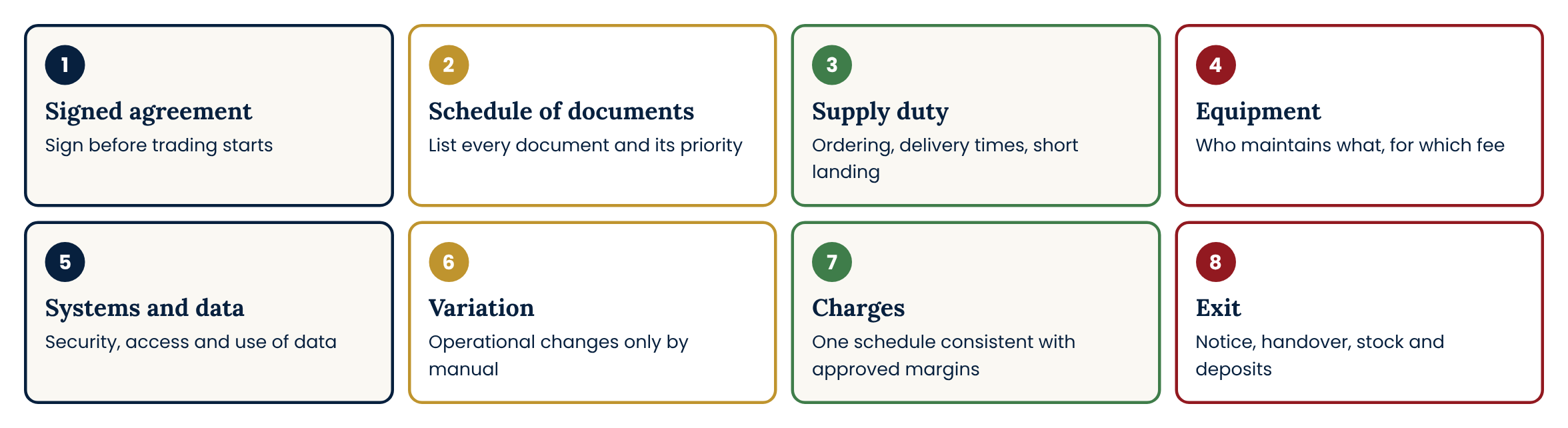
Figure 3. Drafting checklist for a petrol franchise agreement
IX. Questions every participant should answer
What documents make up the contract? The parties should list every document, check which were signed or properly incorporated, and identify the order of priority between them.31
What terms does the law imply? Conditions as to description and quality of fuel are implied by statute. Duties to supply, to maintain equipment for which a fee is paid, and to keep a mandated system secure may be implied by the court.32
How must each party exercise the discretions the contract gives it? Honestly, for a proper purpose and not arbitrarily, and, if a Kenyan court follows the English relational contract cases, in good faith.33
9.1 Practical guidance for oil marketing companies
Companies should sign agreements before trading begins, keep a single schedule of documents that make up the contract, and give dealers copies of every manual and policy. They should limit variation powers to operational matters, introduce economic changes by signed variation, and ensure that any system they mandate is secure and that responsibility for it is clearly allocated.
9.2 Practical guidance for dealers
Dealers should not begin trading on an offer letter without understanding that its terms may govern the whole relationship. They should ask for the manual and all policies before signing, keep records of supply, maintenance and system failures, and object in writing to changes in charges that were not agreed.
X. Conclusion
A petrol dealer agreement is a franchise in all but name, and in Kenya it is governed by the general law rather than by a franchise statute. That places weight on the documents, on the terms the courts will imply and on the developing question of good faith. Njane shows that Kenyan courts will hold an oil company to obligations that flow from the control it exercises and the fees it charges. Companies and dealers who ask the 3 questions in this edition before they sign will have fewer surprises when the relationship is tested.
Benson Odiwuor is an Advocate of the High Court of Kenya based in Nairobi, whose practice focuses on dispute resolution in the regulated industries, including mining, oil and gas, banking and project finance. He is the editor of The BOLD, Benson Odiwuor’s Legal Digests, a legal newsletter on dispute strategies and legal developments in the regulated industries of Kenya. Subscribe to The BOLD here.
For inquiries, contact the author at info@bensonodiwuor.com.
References
- Njane t/a Argwings Twin Service Station & another v Total Kenya Limited & another (Civil Case 433 of 2010) [2025] KEHC 14898 (KLR) paras 3 to 8 and 159 <https://new.kenyalaw.org/akn/ke/judgment/kehc/2025/14898/eng@2025-10-24>. ↩
- ‘Court Sets Precedent in Sh138 Million Franchise Dispute against Total Kenya’ The Standard (Nairobi, October 2025) <https://thestandard.ke/business/amp/courts/article/2001533270/court-sets-precedent-in-sh138-million-franchise-dispute-against-total-kenya>. ↩
- International Trade Administration, ‘Kenya Country Commercial Guide. Distribution and Sales Channels’ (US Department of Commerce) <https://www.trade.gov/country-commercial-guides/kenya-distribution-sales-channels>. ↩
- ‘Oil Majors Overcharging Petrol Station Owners’ Business Daily (Nairobi, 22 May 2025) <https://www.businessdailyafrica.com/bd/corporate/industry/oil-majors-overcharging-petrol-station-owners-5053294>; Petroleum (Retail Dispensing Site Construction and Licensing) (No 2) Regulations 2025 (LN 188 of 2025) regs 10 to 17 <https://epra.go.ke/extras/legal/web/uploads/6a5f3964c4b13_The%20Petroleum%20(Retail%20Dispensing%20Site%20Construction%20and%20Licensing)(No%202)%20Regulations.pdf>. ↩
- Law of Contract Act (Cap 23) s 2. ↩
- Njane (n 1) paras 79 to 86; RTS Flexible Systems Ltd v Molkerei Alois Müller GmbH & Co KG [2010] UKSC 14. ↩
- Sale of Goods Act (Cap 31) ss 15 and 16 <https://new.kenyalaw.org/akn/ke/act/1930/33/eng@1964-11-03>. ↩
- Petroleum Act 2019 (No 2 of 2019), now Cap 308 of the Laws of Kenya s 92 <https://new.kenyalaw.org/akn/ke/act/2019/2>. ↩
- Trade Marks Act (Cap 506). ↩
- Competition Act 2010 (No 12 of 2010), now Cap 504 of the Laws of Kenya s 21. ↩
- The Moorcock (1889) 14 PD 64 (CA); BP Refinery (Westernport) Pty Ltd v Shire of Hastings (1977) 180 CLR 266 (PC). ↩
- Njane (n 1) paras 106 to 111. ↩
- Njane (n 1) paras 112 to 119 and 159. ↩
- Njane (n 1) paras 92 to 96. ↩
- Njane (n 1) paras 104, 105 and 147. ↩
- Njane (n 1) para 100. ↩
- Njane (n 1) para 100. ↩
- Yam Seng Pte Ltd v International Trade Corporation Ltd [2013] EWHC 111 (QB). ↩
- Bates v Post Office Ltd (No 3) [2019] EWHC 606 (QB). ↩
- Law of Contract Act s 2; Bates (n 19). ↩
- Njane (n 1) para 159; Bates (n 19). ↩
- ‘Oil Majors Overcharging Petrol Station Owners’ (n 4). ↩
- Law of Contract Act s 2. ↩
- Njane (n 1) paras 117 to 119. ↩
- Njane (n 1) paras 27 to 31 and 79 to 86. ↩
- Njane (n 1) para 62. ↩
- Kileleshwa Service Station Ltd v Kenya Shell Ltd (Civil Appeals 205 and 239 of 2008) [2012] KECA 13 (KLR) <https://new.kenyalaw.org/akn/ke/judgment/keca/2012/13/eng@2012-04-20>. ↩
- ‘Oil Majors Overcharging Petrol Station Owners’ (n 4). ↩
- Yam Seng (n 18); Bates (n 19); Njane (n 1) para 100. ↩
- ‘Oil Majors Overcharging Petrol Station Owners’ (n 4). ↩
- Njane (n 1) paras 79 to 86. ↩
- Sale of Goods Act ss 15 and 16; Njane (n 1) paras 92 to 96, 110, 111 and 117 to 119. ↩
- Bates (n 19); Yam Seng (n 18). ↩