
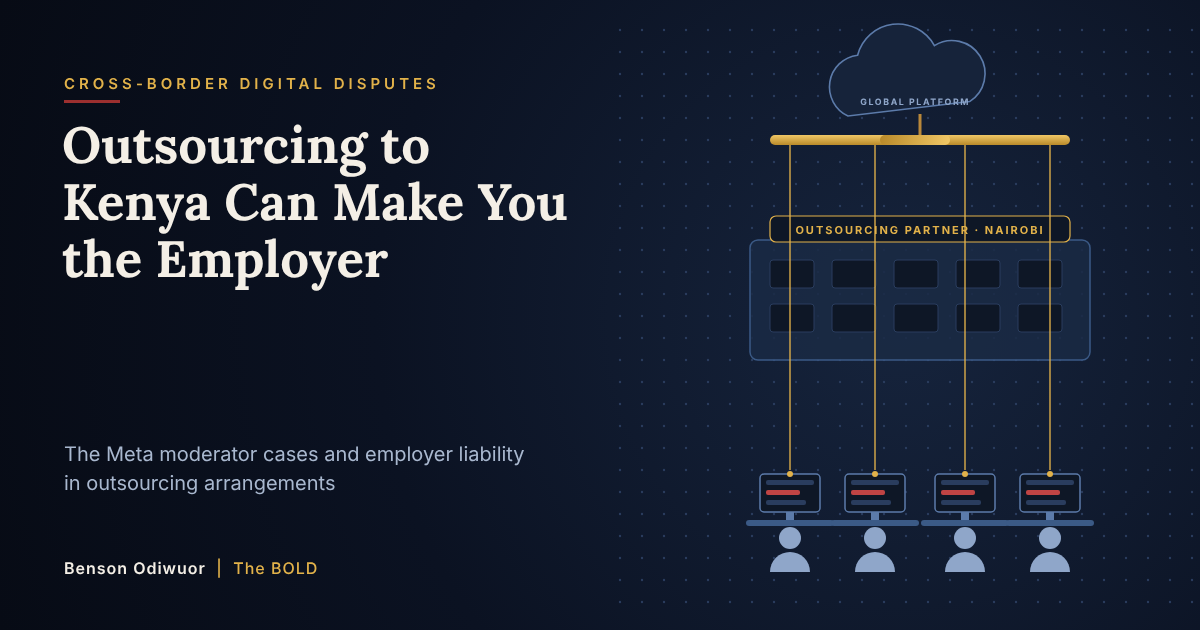
Outsourcing to Kenya Can Make You the Employer
27 October 2026
Kenya has become one of Africa's leading destinations for business process outsourcing. Global technology companies, airlines, banks and telecoms providers engage Kenyan firms to moderate content, label data for artificial intelligence, answer customer calls and process transactions. The structure is usually the same: the global company contracts with a Kenyan outsourcing firm, the firm employs the workers, and the global company assumes that any employment dispute is the outsourcing firm's problem.
The litigation brought by Facebook content moderators in Nairobi has put that assumption under serious strain. A Kenyan court has already held, at an interim stage, that the global company behind the work was the moderators' principal employer. That finding was later set aside on procedural grounds, but the question it raised has not gone away, and the answer will matter to every multinational that outsources work to Kenya.
Who is an employer under Kenyan law
The starting point is the Employment Act. It defines an employer as any person, public body, firm, corporation or company who or which has entered into a contract of service to employ any individual, and includes the agent, foreman, manager or factor of such a person or company.1 The definition does not confine the status of employer to the entity named on the employment contract. It expressly contemplates that one party may act as the agent of another, and that both may be treated as employers.
That matters because the obligations that attach to an employer are substantial. They include the statutory procedure for redundancy, protection against unfair termination, and obligations relating to health, safety and working conditions. A global company found to be an employer may share those obligations, and the corresponding liabilities, with its Kenyan outsourcing partner.
The ruling that named Meta the employer
In Arendse v Meta Platforms, Inc, content moderators engaged by Samasource Kenya EPZ Ltd, trading as Sama, to review content on Facebook challenged their redundancy, alleging that it was retaliatory and unlawful. Among other things, they sought interim orders restraining the redundancy and requiring proper psychological care.
In a ruling delivered in June 2023, Justice Ongaya held that the Meta companies were the primary or principal employers of the moderators, and that Sama was merely their agent, foreman, manager or factor within the meaning of the Employment Act. The court relied on several features of the arrangement. The content belonged to Meta, and the work was carried out through a system designed by Meta. Meta exercised control by imposing operational requirements and standards of performance, its system tracked the moderators' tickets, metrics and time, and Meta funded the pay that Sama passed on. The court accepted that Meta was free to outsource the work, but held that, in the absence of any disclosed outsourcing contract showing how obligations had been allocated, nothing in the arrangements absolved Meta of its position as principal employer.2 In reaching that conclusion, the court drew on English authority, including Cable & Wireless plc v Muscat, in which the English Court of Appeal held that a worker supplied through an intermediary could be found to have an implied contract of employment with the end user.3
The Court of Appeal's correction
The Court of Appeal set the ruling aside in its entirety. It held that the questions whether Meta was the principal employer and whether Sama was its agent were contested issues of fact that should have been reserved for the full hearing. In making definitive findings on those issues at the interim stage, the trial judge had impermissibly and dangerously delved into contested issues of fact and law, and had in effect written a final judgment rather than an interlocutory ruling. Several of the interim orders, including the extension of lapsing contracts and orders requiring medical and psychiatric care, were in substance final orders that should not have been granted before a hearing on the merits.4
The appellate decision is important, but it is important to read it accurately. The Court of Appeal did not hold that Meta was not the employer. It held that the question could only be answered after evidence had been tested at trial. In a separate judgment delivered on the same day, the court made the same point in rejecting Meta's challenge to the court's jurisdiction, holding that whether the moderators were employed by the Meta companies was a question of fact to be determined at a full hearing.5 The substantive question therefore remains open, and the factors on which the trial court relied remain the factors on which the dispute will be decided.
Beyond contract: control and constitutional rights
The moderators' claims were brought as constitutional petitions, and that choice has consequences for outsourcing structures. In an earlier ruling in the same case, the Employment and Labour Relations Court addressed whether privity of contract is an essential element in establishing a violation of fundamental rights by a person in control and authority over another, and declined to treat the absence of a direct contract as fatal to the claim against Meta.6 The Court of Appeal has also held that the Constitution binds every person within the Republic, rejecting the argument that the Constitution did not apply to Meta because it is a foreign company.7
The practical effect is that a global company may face claims for violations of the rights to fair labour practices, dignity and health from workers with whom it has no direct contract, provided the workers can show that the company controlled the conditions in which they worked.
The limits of the argument
Not every outsourcing arrangement will turn the client into an employer. The English courts, after Muscat, emphasised that an employment contract with the end user should be implied only where it is necessary to explain the reality of the relationship, and not merely because the worker performs work for the end user's benefit.8 A genuine outsourcing arrangement, in which the Kenyan firm controls recruitment, supervision, discipline and pay, and the client receives only the finished service, is far less exposed than one in which the client's systems, standards and managers direct the workers' daily tasks.
What this means for multinationals
For a global company outsourcing work to Kenya, the lesson is that the legal structure on paper is only the beginning. Kenyan courts will look at who owns the work, who sets the standards, whose systems track performance, who funds the pay and who decides whether workers stay or go. The more of those features that point to the client, the greater the risk that the client will be treated as an employer, or at least as a party responsible for the conditions in which the work is done.
Several steps reduce that risk. The outsourcing contract should allocate employment responsibilities clearly, and should be capable of being disclosed to a court if needed, since the absence of such a contract weighed against Meta. Day-to-day supervision, discipline and welfare should rest genuinely with the Kenyan provider. Where the work carries particular risks, as content moderation does for mental health, the client should satisfy itself that the provider has adequate welfare arrangements in place, because a court may hold the client responsible if those arrangements fail.
For Kenyan workers and their advocates, the same factors show where the evidence lies. Proof of the client's control over systems, metrics, standards and pay is the foundation of any claim that the client, and not only the outsourcing firm, must answer for the way the work was done.
Outsourcing can move the work to Kenya. It does not always move the responsibility away from the company that owns it.
Benson Odiwuor is a Nairobi-based dispute resolution lawyer and researcher in internet jurisdiction, who handles dispute resolution in cross-border digital, data protection and online reputation matters. He is also the editor of The BOLD, a legal newsletter focusing on dispute strategies and legal developments in the regulated industries of Kenya. Subscribe to The BOLD here.
For inquiries, contact the author at info@bensonodiwuor.com.
References
- Employment Act 2007 (Cap 226), s 2. ↩
- Arendse & 42 others v Meta Platforms, Inc & 3 others; Kenya Human Rights Commission & 8 others (Interested Parties) (Constitutional Petition E052 of 2023) [2023] KEELRC 1398 (KLR), paras 27–32. ↩
- Cable & Wireless plc v Muscat [2006] EWCA Civ 220, [2006] ICR 975. ↩
- Samasource EPZ Ltd t/a Sama v Meta Platforms, Incorporated & 186 others; Kenya Human Rights Commission & 8 others (Interested Parties) (Civil Appeal E595 of 2023) [2024] KECA 1152 (KLR), paras 44–66 and 70. ↩
- Meta Platforms, Inc & 2 others v Motaung & 186 others; Kenya National Human Rights and Equality Commission & 14 others (Interested Parties) (Civil Appeal E232 & E445 of 2023 (Consolidated)) [2024] KECA 1262 (KLR), paras 49 and 54. ↩
- Arendse & 182 others v Meta Platforms, Inc & 3 others; Kenya Human Rights Commission & 8 others (Interested Parties) (Constitutional Petition E052 of 2023) [2023] KEELRC 921 (KLR). ↩
- Meta Platforms, Inc & another v Samasource Kenya EPZ Ltd t/a Sama & 185 others; Central Organization of Trade Unions Kenya & 8 others (Interested Parties) (Civil Application E178 of 2023) [2023] KECA 999 (KLR), para 34. ↩
- James v Greenwich London Borough Council [2008] EWCA Civ 35, [2008] ICR 545. ↩