
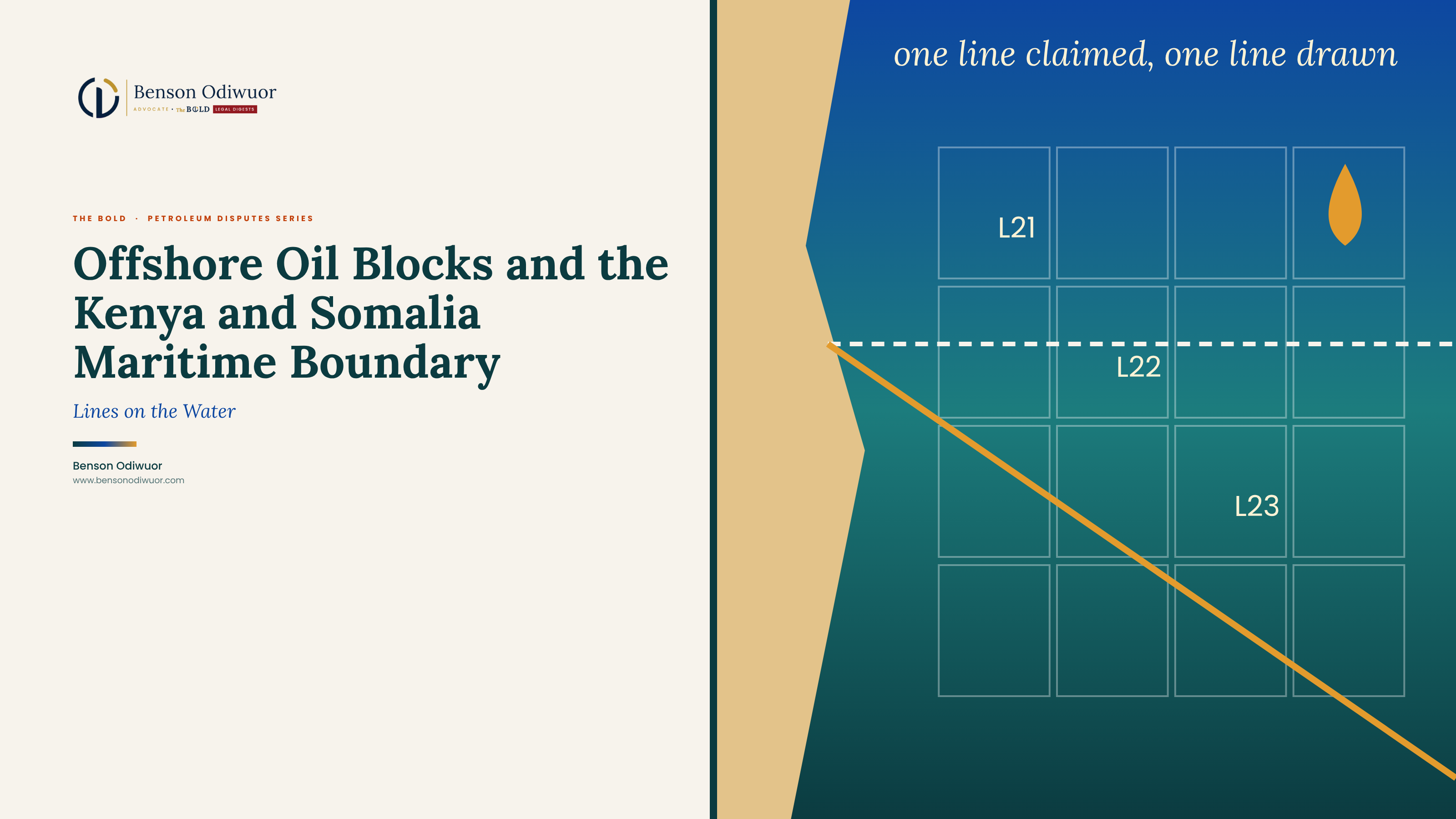
Offshore Oil Blocks and the Kenya and Somalia Maritime Boundary. Lines on the Water
2 November 2026
In 2021 the World Court drew the sea boundary between Kenya and Somalia across licensed oil blocks. The law answers 3 questions. Which State has sovereign rights over the area? What does the contract say when title fails? Which forum will hear the dispute? This edition answers each of them from the law and the judgment.
| KEY POINTS AT A GLANCE On 12 October 2021 the International Court of Justice fixed the maritime boundary between Kenya and Somalia. It held that there was no agreed boundary along the parallel of latitude that Kenya claimed, and drew a line much closer to the one Somalia sought. Kenya did not take part in the oral hearings in March 2021, withdrew its general acceptance of the jurisdiction of the Court in September 2021, and rejected the judgment in totality the day after it was delivered. The judgment is nonetheless final and binding on both States as a matter of international law. Kenya had licensed offshore blocks in the area, including blocks L21, L23 and L24 to Eni and L22 to Total. The Court rejected the claim by Somalia that Kenya had breached its obligations by those activities. The licences held by Eni for L21, L23 and L24 were reported to expire in December 2024, with no operations carried out because of the dispute. Somalia has since run licensing rounds that include acreage in the Lamu basin. The boundary is settled in law but contested in practice. That leaves licence holders, investors and both States with exposure on title, contract and treaty claims. Every question about offshore acreage near the boundary turns on 3 points. Which State has sovereign rights over the area under the judgment? What do the licence and the contract say when title fails or operations cannot proceed? Which forum will hear the dispute? |
I. Introduction
Off the coast of Lamu, the seabed is thought to hold oil and gas. For most of the last 50 years Kenya treated its maritime boundary with Somalia as running due east along a parallel of latitude, and it drew its offshore oil blocks on that basis. Somalia maintained that the boundary should continue the direction of the land border to the southeast. The difference created a triangle of about 100,000 square kilometres claimed by both States.1
In 2014 Somalia took the dispute to the International Court of Justice. In 2021 the Court drew the boundary, awarding most of the triangle to Somalia and a smaller part to Kenya.2 Kenya rejected the judgment.3 In 2026 the line remains settled in law and unsettled in politics, and the oil blocks that Kenya licensed in the area have not been developed.4
This edition of The BOLD explains, from the ground up, the law that governs maritime boundaries, what the Court decided, and what follows for the oil blocks and the companies that held them. It sets out the international and domestic framework, examines the case and its aftermath, and closes with an analysis of the options open to licence holders and the State. It takes no position on the policy of either Government.
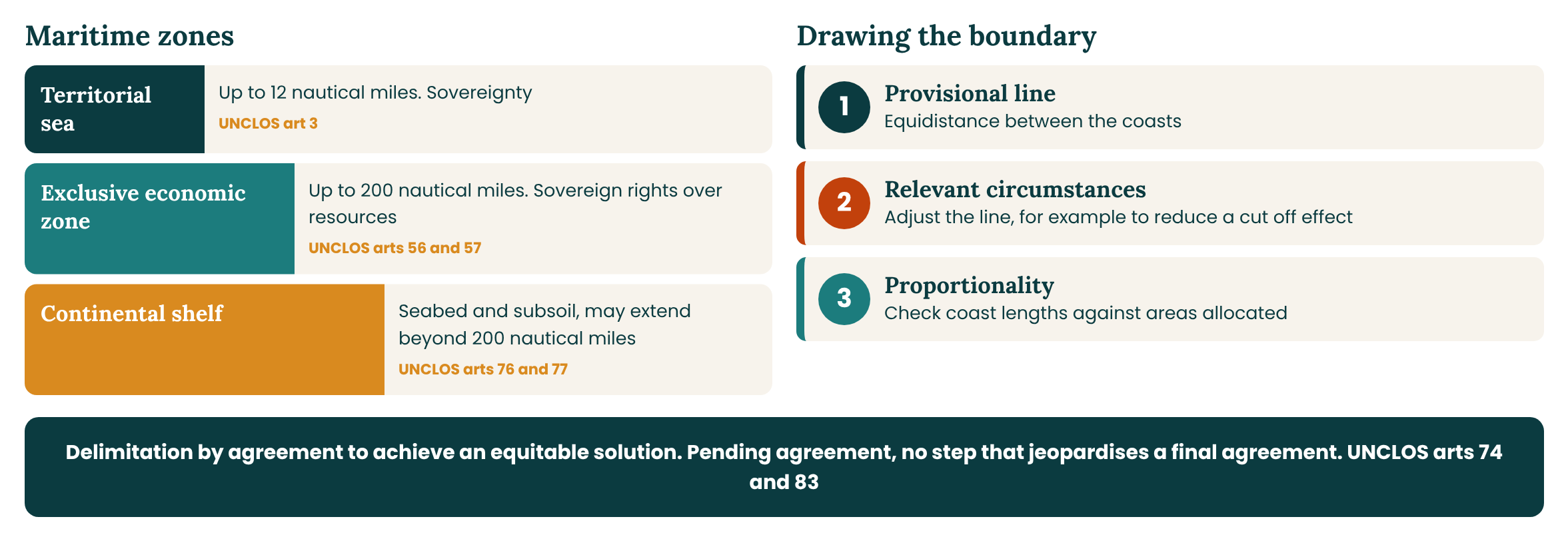
Figure 1. Maritime zones under UNCLOS and the 3 stages the Court uses to draw a boundary
II. Foundational concepts
2.1 Maritime zones
Under the United Nations Convention on the Law of the Sea, a coastal State has a territorial sea of up to 12 nautical miles, an exclusive economic zone of up to 200 nautical miles, and a continental shelf that may extend beyond 200 nautical miles where the natural prolongation of its land territory continues.5 In the economic zone and on the continental shelf, the State has sovereign rights to explore and exploit natural resources, including oil and gas.6 Kenya and Somalia are both parties to the Convention.
2.2 Delimitation
Where the zones of 2 States overlap, the boundary must be drawn, or delimited. The Convention requires delimitation of the economic zone and continental shelf by agreement on the basis of international law, in order to achieve an equitable solution.7 Pending agreement, the States must make every effort to enter into provisional arrangements of a practical nature and must not jeopardise or hamper the reaching of a final agreement.8
2.3 Method of delimitation
When a court draws the boundary, it usually follows 3 stages. It draws a provisional equidistance line. It considers whether relevant circumstances call for that line to be adjusted. It then checks that the result does not produce a marked disproportion between the ratio of the coastlines and the ratio of the areas allocated.9 The Court applied that method in this case.
2.4 Oil block
An oil block is an area of land or seabed that a State offers for exploration under a production sharing contract or licence. The contract gives the holder the right to explore and, if it finds oil in commercial quantities, to develop and produce it, subject to the terms agreed. If the State turns out not to have sovereign rights over part of the block, the contract cannot give the holder rights that the State itself did not have.
III. Legal framework
3.1 International law
A judgment of the International Court of Justice binds the parties in respect of the particular case and is final and without appeal.10 Each member of the United Nations undertakes to comply with a decision of the Court in any case to which it is a party, and if a party fails to do so, the other may have recourse to the Security Council.11 The Court had jurisdiction in this case because both States had accepted its jurisdiction under the optional clause in Article 36(2) of its Statute, as the Court found in 2017.12
3.2 Constitution of Kenya
The general rules of international law form part of the law of Kenya, and any treaty or convention ratified by Kenya forms part of the law of Kenya under the Constitution.13 Kenya has ratified UNCLOS. The Maritime Zones Act defines the maritime zones of Kenya in domestic law.14 Petroleum rights in those zones are granted under the Petroleum Act 2019.15
3.3 Petroleum contracts
The Petroleum Act provides for petroleum agreements between the Government and contractors, which set out the area, the work programme, the periods of exploration and the rights and obligations of each party.16 The contracts usually contain provisions on force majeure, extension of time, relinquishment, applicable law and arbitration. Those provisions decide what happens when operations cannot proceed, including because of a dispute over title.
IV. Case and aftermath
4.1 Proceedings
Somalia filed its application on 28 August 2014. Kenya objected to the jurisdiction of the Court, arguing among other things that a memorandum of understanding signed by the 2 States in 2009 required them to settle the boundary by negotiation. On 2 February 2017 the Court rejected those objections.17 The hearings on the merits were postponed several times at the request of Kenya. When they opened on 15 March 2021, Kenya did not take part.18 In September 2021 Kenya withdrew its declaration accepting the compulsory jurisdiction of the Court under Article 36(2).19
4.2 Judgment of 12 October 2021
The Court held that there was no agreed maritime boundary between Somalia and Kenya following the parallel of latitude. It found no clear and consistent acceptance by Somalia of that line, and held that the oil concession blocks drawn by each State did not by themselves establish a boundary.20 It then drew a single maritime boundary using the 3 stage method. It adjusted the provisional equidistance line to reduce the effect of the line in cutting off Kenya from the sea.21 The result gave Somalia most of the disputed triangle, while Kenya kept a part of it.22
The Court also rejected the claim by Somalia that Kenya had violated its international obligations by its activities in the disputed area. That claim covered the award of oil blocks L5, L13, L21, L22, L23, L24 and L26 and the surveys carried out in them. The Court noted that several of the activities complained of, such as the award of blocks and seismic surveys, were of a transitory character. It concluded that it could not be found that the activities of Kenya had jeopardised or hampered the reaching of a final agreement on the boundary.23
The Court held that oil blocks do not draw a boundary. It also held that drawing them was not, on the facts, a breach of international law.
4.3 Reaction of Kenya
On 13 October 2021 the President of Kenya rejected the decision in totality, describing it as clearly erroneous and as a jurisdictional overreach.24 The position of Kenya is that it did not consent to the Court deciding the case. The position in international law is that consent was given through the optional clause declarations in force when Somalia filed its application, and that withdrawing the declaration later does not affect a case already pending.25
4.4 Oil blocks
Kenya awarded production sharing contracts for blocks L21, L23 and L24 to Eni, and for L22 to Total, in the deep and ultra deep waters of the Lamu basin.26 Analysts have estimated that about 75 per cent of the area of 3 concessions held by one major company falls on the Somali side of the boundary drawn by the Court.27 Before the judgment, analysts warned that Kenya might be contractually required to compensate companies if the ruling went against it.28
In late 2024 a report of the Ministry of Energy and Petroleum stated that the licences for blocks L21, L23 and L24 were set to expire in December 2024, and that no petroleum operations had taken place in them because of the maritime dispute.29 On the Somali side, the Somali Petroleum Authority launched a licensing round in 2024 offering 26 offshore blocks in the Somali and Lamu basins, to close in 2026.30 In 2019 the 2 States had already clashed when Kenya accused Somalia of offering blocks in the disputed area at a conference in London, which Somalia denied.31

Figure 2. Kenya and Somalia boundary dispute from 2012 to 2026
V. Analysis
5.1 Binding effect and non acceptance
The judgment is binding on Kenya in international law whether or not Kenya accepts it.32 Non acceptance has practical effects, however. Kenya may continue to assert its claim in diplomacy, and enforcement through the Security Council is political and uncertain. For a company, the result is that neither State can offer a clean title to acreage on the Somali side of the line without risk. A Kenyan licence over that area would conflict with the judgment, and a Somali licence over it would face political objection from Kenya.
5.2 Kenyan licences beyond the line
The Constitution makes the general rules of international law and ratified treaties part of the law of Kenya.33 A Kenyan court asked to give effect to a petroleum right over an area that the Court has placed within the zone of Somalia would therefore have to consider the binding judgment. Whatever position the Government takes, a licence holder cannot assume that a Kenyan licence alone will support investment in that area.
5.3 Contractual position of licence holders
The effect on each holder depends on its contract. The questions are whether the inability to operate is force majeure, whether the exploration period was extended or suspended, whether the State gave any warranty of title, and how the contract treats relinquishment and termination. Where a contract lapses after a period in which no work could be done, as reported for L21, L23 and L24, the holder may have claims for extension, return of security or compensation, and the State may have defences based on the terms agreed.34 Most such contracts provide for international arbitration.
5.4 Treaty claims
Where the holder is protected by an investment treaty between Kenya and its home State, a separate route may be open. The holder may argue that the State failed to accord fair and equitable treatment or frustrated legitimate expectations. The State may answer that an investor in a known disputed area accepted the risk of the boundary going against it. The outcome would turn on the treaty, the facts and the timing of the investment.
5.5 Future licensing
For new acreage, the boundary drawn by the Court is the only line with legal authority. Kenya can license with confidence on its own side of it. Any licensing that crosses it would invite dispute. A joint development or provisional arrangement under Articles 74(3) and 83(3) of UNCLOS remains a lawful option if the 2 States choose cooperation over contest.35
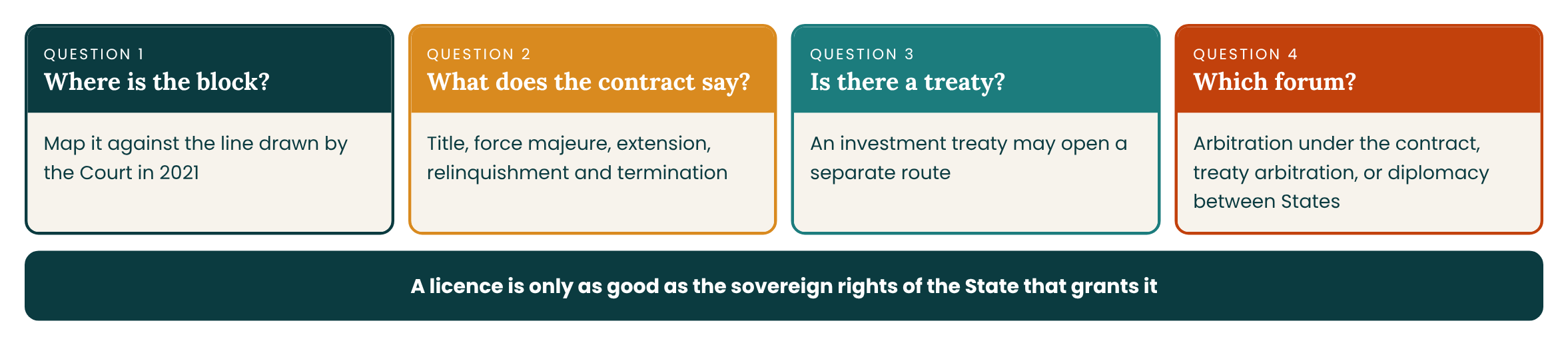
Figure 3. Questions a holder of offshore acreage near the boundary must answer
Table 1. Legal position after the judgment of 2021
| Issue | Position |
|---|---|
| Is the boundary binding? | Yes, on both States under Article 59 of the Statute and Article 94 of the Charter |
| Does non acceptance by Kenya change that? | Not in international law. It affects enforcement and the practical climate for investment |
| Did Kenya breach international law by licensing the blocks? | No. The Court rejected that claim by Somalia |
| What happens to Kenyan contracts over areas now on the Somali side? | Depends on the contract. Questions of force majeure, extension, title and arbitration arise |
| Can Kenya license new acreage near the line? | Yes on its own side. Crossing the line invites dispute |
VI. Next round
6.1 Questions every holder should answer
Table 2. Questions every holder of offshore acreage near the boundary should be able to answer
| Question | Why it matters |
|---|---|
| Where does the block lie in relation to the line drawn by the Court? | Rights on the Somali side cannot safely rest on a Kenyan licence |
| Did the contract give any warranty or representation of title? | That affects whether the State bears the risk |
| Was force majeure notified, and was time extended? | Lapse without extension may close some remedies |
| Which law governs, and where is arbitration seated? | The forum decides how international law is applied |
| Is there an investment treaty between Kenya and the home State? | A treaty may open a further route to a remedy |
6.2 What each party should do
Table 3. Practical guidance drawn from the law and the judgment
| Party | What the law and the judgment counsel |
|---|---|
| Holders of existing or lapsed contracts | Map each block against the boundary. Preserve the record of notices, extensions and correspondence. Take advice on contractual and treaty claims before limitation periods run |
| Prospective investors | Treat the line drawn by the Court as the legal boundary. Seek express contractual allocation of boundary risk |
| The Ministry of Energy and Petroleum | Publish block maps that show the line drawn by the Court. Address the position of lapsed contracts in writing |
| Both Governments | Consider provisional or joint arrangements under UNCLOS, which the Convention expressly encourages |
VII. Conclusion
The dispute over the maritime boundary between Kenya and Somalia was decided by the International Court of Justice in 2021, but it has not been resolved in practice. The Court rejected the parallel of latitude, drew a line closer to the claim of Somalia, and declined to find that Kenya acted unlawfully in licensing the blocks. Kenya rejected the decision, and the blocks it licensed in the area have not been developed.
For the petroleum sector the lesson is clear. A licence is only as good as the sovereign rights of the State that grants it, and a boundary fixed by the Court is the only line that international law recognises. Investors should price that risk, holders should protect their contractual position, and both States would do well to consider the cooperative arrangements that the Law of the Sea Convention invites.
Benson Odiwuor is an Advocate of the High Court of Kenya based in Nairobi, whose practice focuses on dispute resolution in the regulated industries, including mining, oil and gas, banking and project finance. He is the editor of The BOLD, Benson Odiwuor’s Legal Digests, a legal newsletter on dispute strategies and legal developments in the regulated industries of Kenya. Subscribe to The BOLD here.
For inquiries, contact the author at info@bensonodiwuor.com.
References
- ‘Somalia, Kenya Dispute: What ICJ Judgment Says’ Daily Nation (Nairobi, 12 October 2021) <https://nation.africa/kenya/news/somalia-kenya-dispute-what-icj-judgment-says-3581062>; ‘Kenya Rejects ICJ’s Verdict on Somalia Maritime Border Row’ Al Jazeera (13 October 2021) <https://www.aljazeera.com/news/2021/10/13/kenya-rejects-icjs-verdict-on-somalia-maritime-border-row>. ↩
- Maritime Delimitation in the Indian Ocean (Somalia v Kenya) (Judgment) [2021] ICJ Rep 206 <https://www.icj-cij.org/public/files/case-related/161/161-20211012-JUD-01-00-EN.pdf>; Timothy Walker, ‘ICJ Draws the Line in Kenya and Somalia’s Troubled Waters’ ISS Today (October 2021) <https://issafrica.org/iss-today/icj-draws-the-line-in-kenya-and-somalias-troubled-waters>. ↩
- International Boundaries Research Unit, Durham University, ‘ICJ Rules on Kenya Somalia Maritime Dispute’ (15 October 2021) <https://www.durham.ac.uk/research/institutes-and-centres/ibru-borders-research/news-and-events/boundary-news/kenya-somalia-maritime-dispute-icj-decision/>. ↩
- ‘Kenya Oil Block Licences Expiry Rekindles Somalia Border Row’ Business Daily (Nairobi, December 2024) <https://www.businessdailyafrica.com/bd/corporate/industry/kenya-oil-block-licences-expiry-rekindles-somalia-border-row-4866862>. ↩
- United Nations Convention on the Law of the Sea (adopted 10 December 1982, entered into force 16 November 1994) 1833 UNTS 3 arts 3, 57 and 76. ↩
- UNCLOS arts 56 and 77. ↩
- UNCLOS arts 74(1) and 83(1). ↩
- UNCLOS arts 74(3) and 83(3). ↩
- Somalia v Kenya (n 2). ↩
- Statute of the International Court of Justice 1945 arts 59 and 60. ↩
- Charter of the United Nations 1945 art 94. ↩
- Maritime Delimitation in the Indian Ocean (Somalia v Kenya) (Preliminary Objections) [2017] ICJ Rep 3. ↩
- Constitution of Kenya 2010 art 2(5) and (6). ↩
- Maritime Zones Act (Cap 371). ↩
- Petroleum Act 2019 (No 2 of 2019), now Cap 308 of the Laws of Kenya <https://new.kenyalaw.org/akn/ke/act/2019/2>. ↩
- Petroleum Act 2019. ↩
- Somalia v Kenya (Preliminary Objections) (n 12); ‘Kenya Boycotts ICJ Hearing on Somalia Sea Boundary Row’ Al Jazeera (15 March 2021) <https://www.aljazeera.com/news/2021/3/15/kenya-boycotts-world-court-hearing-on-somalia-sea-boundary-row>. ↩
- ‘Kenya Rejects ICJ Verdict’ (n 1); ‘Kenya Boycotts ICJ Hearing’ (n 17). ↩
- Kenya, Withdrawal of the Declaration under Article 36(2) of the Statute of the International Court of Justice, UN Doc C.N.281.2021.TREATIES (2021), as cited in (2022) 61 International Legal Materials <https://www.cambridge.org/core/journals/international-legal-materials/article/maritime-delimitation-in-the-indian-ocean-som-v-kenya-icj/7D7F76A302095EFD18B97B0D0139B9C9>. ↩
- Somalia v Kenya (n 2); Walker, ‘ICJ Draws the Line’ (n 2). ↩
- Somalia v Kenya (n 2); International Court of Justice, ‘Maritime Delimitation in the Indian Ocean (Somalia v. Kenya): Overview of the Case’ <https://www.icj-cij.org/case/161>. ↩
- ‘What ICJ Judgment Says’ (n 1); ‘Kenya Rejects ICJ Verdict’ (n 1). ↩
- Somalia v Kenya (n 2); ‘What ICJ Judgment Says’ (n 1). ↩
- IBRU, ‘ICJ Rules on Kenya Somalia Maritime Dispute’ (n 3). ↩
- Somalia v Kenya (Preliminary Objections) (n 12); ICJ Statute art 36. ↩
- ‘Kenya: Majors Snap Up Ultra-Deep Blocks’ Africa Energy Intelligence (2012) <https://www.africa-energy.com/news-centre/article/kenya-majors-snap-ultra-deep-blocks>; ‘Kenya: Total Awarded Lamu Deepwater License’ Oil and Gas Journal<https://www.ogj.com/exploration-development/article/17273852/kenya-total-awarded-lamu-deepwater-license>. ↩
- ‘The World Court Fixes the Somalia-Kenya Maritime Boundary: Technical Considerations and Legal Consequences’ (2021) 25(25) ASIL Insights<https://www.asil.org/insights/volume/25/issue/25>. ↩
- S&P Global Market Intelligence, ‘Kenya-Somalia Boundary Dispute’ <https://www.spglobal.com/marketintelligence/en/mi/research-analysis/kenyasomalia-boundary-dispute.html>. ↩
- ‘Kenya Oil Block Licences Expiry’ (n 4). ↩
- ‘Licensing Rounds Fueling Sub-Saharan Africa’s O&G Expansion’ Prospect (2024) <https://prospect-intel.com/licensing-rounds-sub-saharan-africa-oil-gas/>. ↩
- International Crisis Group, ‘UN Court Decision a Fresh Test for Kenya-Somalia Ties’ (October 2021) <https://www.crisisgroup.org/qna/africa/kenya/un-court-decision-fresh-test-kenya-somalia-ties>. ↩
- ICJ Statute art 59; UN Charter art 94(1). ↩
- Constitution of Kenya 2010 art 2(5) and (6). ↩
- ‘Kenya Oil Block Licences Expiry’ (n 4). ↩
- UNCLOS arts 74(3) and 83(3). ↩