
Judicial Review Remedies in Kenya After 2010 and after the 2024 Rules
13 October 2026
Introduction
Judicial review in Kenya now looks confused, and the confusion is often blamed on the Supreme Court of Kenya. Practitioners ask whether leave still matters, whether a court can award a declaration or damages, and whether merit review is now allowed. The answers they get depend on which case they read first.
This article shows why the Supreme Court has not contradicted itself. The Supreme Court has been describing three different proceedings that share one name. The remedies available, the depth of the court’s inquiry, and whether you need leave all follow from one question. On what legal foundation did you commence and plead your case?
This article first shows how the Court of Appeal came to that idea, then how the Supreme Court fixed it, and then what the Fair Administrative Action Rules, 2024 changed. It also deals with the fact that important parts of those Rules are suspended. A careful drafter has to keep that in view.
Why the law has three layers
Before 2010, judicial review had a single home. Sections 8 and 9 of the Law Reform Act gave the High Court its jurisdiction, and Order 53 of the Civil Procedure Rules supplied the procedure. The remedies were
(i) certiorari,
(ii) mandamus and
(iii) prohibition.
The grounds were:
(i) illegality,
(ii) irrationality and
(iii) procedural impropriety ( where the court examined the decision making process and not the merits).
The Constitution of Kenya, 2010 added two more layers.
(i) Article 23(3)(f) lists an order of judicial review among the reliefs available for enforcing the Bill of Rights, and
(ii) Article 47 guarantees administrative action that is expeditious, efficient, lawful, reasonable and procedurally fair.
Parliament then enacted the Fair Administrative Action Act, 2015 to give effect to Article 47. The Act sets out grounds of review in section 7 and orders in section 11. Section 12 says the Act is in addition to the common law and the rules of natural justice and does not derogate from them.
The Act did not repeal the Law Reform Act or Order 53 of the Civil Procedure Rules, and neither has been declared unconstitutional. All three layers are therefore the law at once.
Where the dual approach first appeared, the Butali Sugar case
The first appellate decision to separate the layers is West Kenya Sugar Company Limited v Kenya Sugar Board & another (Civil Appeals 89 and 90 of 2011, consolidated) [2014] KECA 287 (KLR), decided at Kisumu on 19 September 2014 by Githinji, Onyango Otieno and Kantai JJA. Butali Sugar Mills Limited is the second respondent, and the case is usually cited under its name.
The facts are a dispute over a sugar milling licence. Butali sought mandamus to compel the Kenya Sugar Board to issue it an operating licence. The application was filed four days after it applied for the licence, while a competing miller, West Kenya Sugar, was already litigating the same sugar zone in the High Court and had obtained conservatory orders in a constitutional petition. The High Court shut West Kenya Sugar out of the judicial review hearing and granted mandamus compelling the Board to issue the licence.
The Court of Appeal’s reasoning contains four lessons that are still current.
(a) The two stages.
The Court described judicial review under Order 53 as a two stage process. The first stage is an application for leave, a threshold test of whether there is an arguable case, and the second is the hearing of the substantive application. It borrowed Lord Diplock’s explanation that the threshold stage filters out busybodies and abuse without going into the merits in depth. This is the origin of the leave and substantive stage that practitioners now ask about.
(b) The narrow jurisdiction.
The Court said that a judicial review application brought under the Law Reform Act and Order 53 exercises narrow jurisdiction over the decision-making process. It held that mandamus cannot compel a licensing authority to grant a licence where the statute leaves the decision to the authority. Demand and refusal must precede mandamus, and the proper order for delay is to compel the authority to hear and determine the application according to law. The Court set aside the mandamus compelling the licence and substituted an order compelling the Board to hear and determine Butali’s application, with West Kenya Sugar entitled to be heard in opposition.
(c) The two doors.
This is the passage that matters most for the present debate. The Court observed that Article 23(3)(f) of the Constitution of Kenya expanded judicial review for breaches of fundamental rights, and that deciding such a breach is likely to involve the merits and not merely the process. It said that proceedings to enforce the Bill of Rights may be instituted under Article 22 and that in them the High Court may grant certiorari, prohibition or mandamus as a remedy. It added that judicial review under the Law Reform Act and Order 53 is not the proper procedure for enforcing the Bill of Rights.
In 2014 the Court of Appeal had already said that the depth of review and the available remedies depend on the procedure invoked. The Supreme Court’s later decision in Dande says the same thing with greater authority.
(d) Liberal standing.
The Court held that Article 22, Article 258 and Article 159(2)(d) call for a liberal approach to standing in public law, and that the right to be heard in opposition under Order 53 rule 6 is available to a proper person.
The Court of Appeal widens the review
Two later decisions show how far the Court of Appeal of Kenya was willing to go inside the statutory layer, and where it stopped.
Suchan Investment Ltd v Ministry of National Heritage & Culture & 3 others (Civil Appeal 46 of 2012) [2016] KECA 729 (KLR) read Article 47 and the Fair Administrative Action Act as an implicit shift toward some merit review. The Court reasoned that grounds such as proportionality, relevant considerations and unreasonableness require assessment of facts and to that extent the merits, but that the reviewing court has no power to substitute its own decision and can only remit or make section 11 orders. The Court spoke of a single system grounded in the Constitution in which the common law has been subsumed. As the next section shows, the Supreme Court has not adopted that formulation in full.
Super Nova Properties Ltd & another v District Land Registrar Mombasa & 2 others; Kenya Anti-Corruption Commission & 2 others (Interested Parties) (Civil Appeal 98 of 2016) [2018] KECA 17 (KLR) (19 April 2018) is a practical illustration. The Land Registrar and Commissioner of Lands had revoked the appellants’ titles to parcels forming part of the Mombasa Law Courts by gazette notice. The High Court found that the revocation was ultra vires and without a hearing but declined mandamus and prohibition because of public interest and proportionality.
The Court of Appeal (Visram, Karanja and Koome JJA) took three positions that practitioners should memorise.
First, it saw no fault in the High Court expanding the grounds of review to include proportionality, public trust and justice and equity, and said the proportionality test leads to greater intensity of review.
Second, it said judicial review cannot settle contested questions of ownership, that the facts on which a matter is predicated must not be contested, and that disputes about title are best litigated in the Environment and Land Court. It also made a point about forum choice. The appellants had themselves chosen judicial review, and it was too late on appeal to turn around and say the judge lacked jurisdiction. A litigant is bound by the foundation they chose.
Third, the remedies are neither automatic nor conjoined, and each involves an exercise of discretion. The Court listed reasons why a court may withhold relief, including:
(i) unreasonable or unmeritorious conduct,
(ii) acquiescence,
(iii) futility, and
(iv) public interest.
The court also held that a finding of illegality does not guarantee a remedy. That discretion is a common law feature that does not depend on any Rule.
On the other side stood a line of Court of Appeal decisions holding firmly to process only review. The Supreme Court later recorded these as the second school of thought, citing Kenya Revenue Authority & 2 others v Darasa Investments Ltd (Civil Appeal 24 of 2018) [2018] KECA 358 (KLR) among others. The scene was set for the apex court.
The Supreme Court brings order
The Supreme Court’s decisions are read best in sequence.
SGS Kenya Ltd v Energy Regulatory Commission & 2 others (Petition 2 of 2019) [2020] KESC 64 (KLR) (10 January 2020) the Court held that judicial review is concerned with the process and not the merits. The important detail is that the petitioner had approached the High Court by the prescribed procedures of judicial review. SGS describes the consequence of choosing that procedure. It does not say that every proceeding touching administrative power is limited to process.
John Florence Maritime Services Ltd & another v Cabinet Secretary Transport & Infrastructure & 3 others (Petition 17 of 2015) [2021] KESC 39 (KLR) (6 August 2021) supplied the missing comparison. The Court said Article 47 and the Fair Administrative Action Act allow a judicial review court to consider certain aspects of merit but not to substitute its own decision. It then held that a court hearing a constitutional petition can look beyond the process, substitute a decision, and grant any relief needed to remedy a violation, including structural and supervisory orders. The conclusion was that a High Court determining a judicial review application exercises only a fraction of the jurisdiction it has in a constitutional petition. A judicial review judgment therefore does not bar a later petition on res judicata grounds, because the considerations, procedures and reliefs differ.
Saisi & 7 others v Director of Public Prosecutions & 2 others [2023] KESC 6 (KLR) (27 January 2023) charted the middle path for the statutory layer. The Court said that applying section 7 of the Fair Administrative Action Act requires some measure of merit analysis, confined to uncontroverted evidence, because controverted evidence is best addressed by the decision maker or a trial court. It gave reasons why judicial review is not a full inquiry or an appeal. Evidence is by affidavit, the reliefs are those in section 11(1) and (2), the court cannot substitute its decision and may only quash it, and where a body exercises discretion it can be directed to act but not told how.
Dande & 3 others v Inspector General, National Police Service & 5 others)(Petitions 6 (E007), 4 (E005) & 8 (E010) of 2022, Consolidated) [2023] KESC 40 (KLR) (16 June 2023) completed the structure. The Court held that a party who approaches the court under the Constitution should get a merit review, while a party who files under Order 53 and claims no violation of rights can have only the process examined.
The operative sentence is that a court cannot issue judicial review orders under the Constitution while confining itself to traditional review, the dual approach exists, and it is determined by the pleadings and procedure adopted at the inception of proceedings. The Court also cited Saisi as speaking to the same issue. It did not treat it as a rival.
The Court of Appeal has since applied this. In Board of Trustees, Telposta Pension Scheme v Retirement Benefits Appeals Tribunal & 3 others (Civil Appeal E767 of 2023) [2024] KECA 1926 (KLR) (20 December 2024) (Kairu, Mativo and Musinga JJA), the applicant had cited Order 53 and also section 11 of the Fair Administrative Action Act. The Court held that the High Court judge erred in limiting himself to process and failing to appreciate that section 7 shows an element of merit review may be required. The decision shows that a properly pleaded statutory foundation lifts a matter above a bare Order 53 application.
The primary key
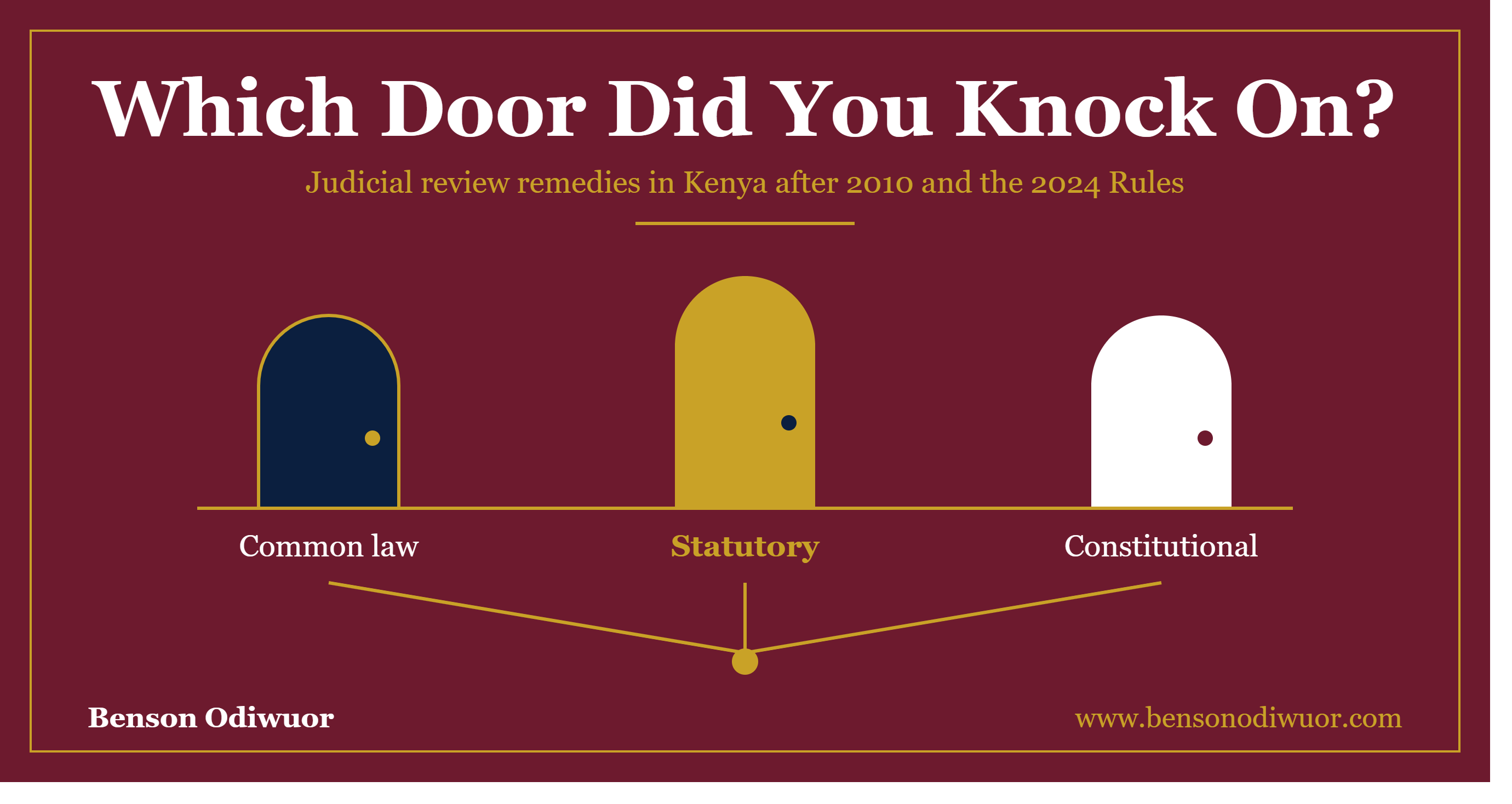
The primary key that should guide the drafter is the foundation pleaded at inception. Everything else follows from it, and it works like a fork with three branches.
(a) The common law branch.
If you commence under sections 8 and 9 of the Law Reform Act and Order 53, you are in the narrow lane that West Kenya Sugar and SGS describe. You need leave, you face the six-month limit for certiorari, and the court examines process and legality only. The remedies are certiorari, mandamus and prohibition. This remains the correct branch where the decision under challenge is not administrative action under the Act.
(b) The statutory branch.
If you commence under the Fair Administrative Action Act and its Rules, you are reviewing administrative action on the section 7 grounds, you are limited to section 11 orders, and the court may weigh uncontroverted material but may not substitute its decision. This is the lane that Saisi, Suchan and Telposta describe.
(c) The constitutional branch.
If you commence by petition under Articles 22, 23 and 165, alleging a violation of a right and pleading it with precision, the court is in merit territory and may grant any appropriate relief, including substitution, compensation and structural orders. This is the lane that John Florence and Dande describe.
Two further questions help a drafter place a case on the fork. The first is whether the facts are contested. Super Nova and Saisi both send contested facts away from judicial review, to the Environment and Land Court in the first and to the trial court in the second. If the facts will be disputed, the honest vehicle is usually a claim or petition that can hear oral evidence. The second is whether a right in the Bill of Rights is truly infringed. If it is, the constitutional branch is open. If the grievance is only that a body acted unlawfully, the statutory branch is the natural home.
The remedies, and how far they stretch
On the common law branch, the three orders do different work.
(i) Certiorari quashes a decision already made,
(ii) prohibition restrains one that is threatened, and
(iii) mandamus compels performance of a duty.
The Butali case reminds us that mandamus is for compelling a decision and not for dictating its content, and that demand and refusal are the preconditions. A licence cannot be ordered where the statute leaves the decision to the licensing authority.
On the statutory branch section 11 of the Fair Administrative Action Act gives the court wide power to make any order that is just and equitable. Rule 27(1) of The Fair Administrative Action Rules, 2024 restates the list. It includes declaring rights, restraining unlawful action, directing reasons, prohibiting action, setting aside and remitting for reconsideration with or without directions, compelling a public duty, temporary relief, and costs or other pecuniary compensation. The limits come from Saisi. The court may quash and remit, and it may compel a decision, but it may not substitute for its own. This follows the Supreme Courts preponement in Kenya Vision 2030 Delivery Board v Commission on Administrative Justice & 2 others (Petition 42 of 2019) [2021] KESC 35 (KLR).
On the constitutional branch Article 23(3) of the Constitution of Kenya allows a declaration of rights, an injunction, a conservatory order, a declaration of invalidity, compensation and an order of judicial review. John Florence confirms that substitution and structural remedies are available, citing Mitu-Bell Welfare Society v Kenya Airports Authority & 3 others (Petition 3 of 2018) [2021] KESC 34 (KLR) (11 January 2021).
How far will a court stretch to save a case? The decisions suggest five boundaries.
The court will read the substance of what you pleaded. In Dande the appellants had pleaded Article 47 and sought Article 23 orders, and that was enough to make the review one on the merits. In Telposta citing section 11 of the Act alongside Order 53 was enough to show the judge had been too narrow.
The court will use its discretion generously within the branch you chose. Section 11 permits orders that are just and equitable, and Rule 4 of the 2024 Rules preserves the court’s power to issue any just and fit order. The same discretion permits a court to withhold relief, as Super Nova shows.
The court will not move you to another branch after the event. Dande fixes the branch at inception, and Super Nova refused to hear a litigant who chose judicial review and then complained of its limits.
The court will not find contested facts for you. Saisi limits merit analysis to uncontroverted evidence, and Super Nova says the facts must not be contested.
The court will not usually rescue a time bar. This is my assessment and not a holding, and it is a reason to count time carefully on whichever branch you choose.
The Fair Administrative Action Rules, 2024
What the Rules do
The Chief Justice made the Rules under section 10(2) of the Act. They were gazetted as Legal Notice 165 of 2024 and took effect on 11 October 2024. They give the statutory branch its own procedure for the first time. The main changes are these.
An application is made by originating motion with a supporting affidavit. Rule 11 provides for this, and there is no leave stage. The motion must state that internal mechanisms and other statutory remedies have been exhausted, which reflects section 9(2) of the Fair Administrative Action Act.
Rule 8 requires the application to be instituted, in the first instance, in the court of the lowest grade competent to hear it. A superior court may transfer the matter. Rule 21 confirms that the High Court, the Employment and Labour Relations Court and the Environment and Land Court may hear judicial review according to subject matter.
The Rules introduce a case management culture.
(i) The respondent files a replying affidavit within seven days of service.
(ii) The court sets the matter down for a case management conference within seven days of the replying affidavit, and may order discovery and referral to alternative dispute resolution.
(iii) The Act itself requires determination within ninety days.
(iv) Rule 38 says an application abates if the section 8 period expires before it is determined, subject to the court’s directions. That abatement rule is a trap for the unwary, and it is not among the suspended provisions.
The Rules also broaden remedies by restating the section 11 of the Fair Administrative Action Act list in Rule 27(1) and (2), including failure to act. Rule 4 preserves the court’s general power to do what is just and fit.
The provisions that are suspended
Some of the most contentious provisions have been suspended. On 28 March 2025 Katiba Institute filed a constitutional petition challenging Rules 5, 6, 7, 11(4), 27(3) and 33. Katiba describes the impugned Rules as reintroducing a notice to sue requirement, imposing shorter timelines for quashing, requiring damages to be pleaded, and limiting the court’s power to grant relief where it would cause hardship or be detrimental to good administration.
Bahati Mwamuye J granted orders suspending the implementation of those Rules, and the orders were confirmed on 4 April 2025. The case is Katiba Institute v State Law Office and the Commission on Administrative Justice (Office of the Ombudsman) & another (Nairobi High Court Constitutional and Human Rights Division Petition E168 of 2025) and it is unreported. In Republic v Judicial Service Commission; Dari Limited & 2 others (Interested Parties); Esho (Ex parte Applicant) [2025] KEHC 4761 (KLR), the court recorded that Rules 5, 6, 7, 11(4), 27(3) and 33 had been stayed when the respondent invoked Rule 5.
Katiba’s argument is that the Rules infringe access to justice under the Constitution. The suspended provisions are interim conservatory orders and not a final declaration of invalidity. As recently as 21 April 2026, Gregory Mutai J gave the Office of the Chief Justice a further 30 days to file its response to the petition.
What this means in practice
With those Rules suspended, a drafter on the statutory branch should work from the following picture, and should check the status of the petition before filing.
The notice of intention to sue under Rule 5, and the Rule 7 conditions that depend on it, are not currently enforceable. For mandamus the practical prudence of a demand and a refusal remains, because West Kenya Sugar requires it as a matter of principle. The Rule 6 six-week period for quashing is suspended, so the governing requirement is the statutory one in section 9(1) of the Act, which is that you must apply without unreasonable delay. The specific pleading requirement for damages in Rule 11(4) is suspended, but nothing prevents sensible pleading of what you seek. Rule 27(3), which lists grounds on which a court may decline a remedy, is suspended, but the court’s inherent discretion to withhold relief, as Super Nova shows, does not depend on it.
The leave position follows from the part of the Rules that is not suspended. Rule 11 provides for an originating motion without a leave stage, and the Katiba petition does not target Rule 11(1) to (3). On the statutory branch there is therefore no leave stage, which is consistent with Kariuki & 22 others v Kiambu County Assembly & 3 others [2017] KEHC 4789 (KLR). There the High Court held that leave is not required when proceedings are instituted under the Fair Administrative Action Act.
The unsettled point is whether Order 53 leave still applies to a matter that could have been brought under the 2024 Rules. The Rules do not repeal Order 53.
Conclusion
The purported confusion in Kenyan judicial review has an explanation. The Court of Appeal in West Kenya Sugar in 2014 already distinguished judicial review under Order 53 from enforcement of the Bill of Rights under Article 22. Suchan and Super Nova showed how far the statutory layer could stretch toward merits without allowing substitution. The Supreme Court in SGS, John Florence, Saisi and Dande then explained that depth of review and the range of remedies follow from the foundation pleaded at the start. The Fair Administrative Action Rules, 2024 gave the statutory branch its own procedure, but the Katiba petition has suspended six of its provisions, so the statutory branch currently rests on the Act, the unsuspended Rules and the court’s inherent discretion.
The practical lesson is the one this article began with. Decide which door you are knocking on, plead it consistently, check the limits for that door, and ask only for remedies that door can give.