
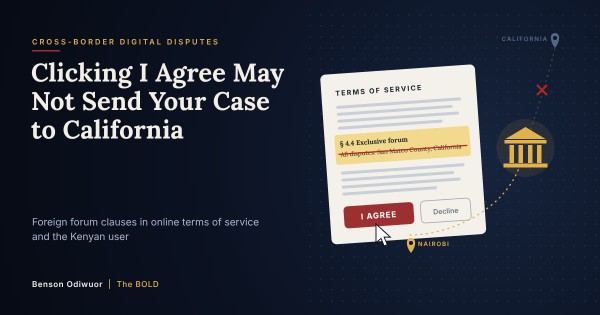
Clicking "I Agree" May Not Send Your Case to California
23 October 2026
A Nairobi business loses access to the advertising account through which it reaches its customers. A Kenyan content creator's channel is demonetised without explanation. A shopper pays for a subscription that never works. Each of them decides to sue, and each discovers the same clause buried deep in the platform's terms of service: every dispute must be resolved exclusively in the courts of California, or Ireland, or before an arbitrator in some distant city.
Most people assume that clause ends the matter. They clicked ‘I agree’, after all. Kenyan law, however, does not treat that click as the final word, and the question whether a Kenyan court will hold a Kenyan user to a foreign forum clause is far more open than the platforms would like their users to believe.
Why platforms insist on a foreign forum
Global platforms serve billions of users under a single set of standard terms, and a forum clause allows them to defend every dispute at home, under familiar law and before courts they know. For the platform, that is sensible risk management. For a user in Kisumu or Mombasa, it can mean that a modest claim is never brought at all, because no one will spend millions of shillings litigating in San Mateo County over an account worth a fraction of that sum.
The clause is therefore rarely about where a dispute is best decided. More often it determines whether the dispute is decided at all, and that is precisely why courts have become willing to look behind it.
The starting point in Kenyan law
Kenyan law begins from respect for the parties' bargain. Electronic contracts are valid, and an agreement concluded by clicking a button is not denied enforceability merely because it was formed by electronic means.1 A forum clause in such a contract is, in principle, as binding as one in a signed paper contract.
That respect has never been absolute. In United India Insurance Co Ltd v East African Underwriters (Kenya) Ltd, the Court of Appeal accepted that the general rule is that a jurisdiction clause must be obeyed, but held that Kenyan courts retain a discretion to assume jurisdiction over an agreement made to be performed in Kenya notwithstanding a clause conferring jurisdiction on a foreign court.2 The English courts express the same principle by requiring a party who sues in breach of an exclusive jurisdiction clause to show strong cause why the clause should not be enforced.3 The burden lies on the party seeking to escape the clause, but it is a burden that can be discharged.
Where the clause requires arbitration rather than litigation abroad, the Arbitration Act directs the court to stay proceedings and refer the parties to arbitration, unless the arbitration agreement is null and void, inoperative or incapable of being performed, or there is in fact no dispute between the parties on the matters agreed to be referred.4 A user who wishes to resist arbitration must therefore bring the case within one of those exceptions.
Did the user really agree?
The first line of attack is formation. A forum clause binds only a person who actually agreed to it, and the way online terms are presented matters. Courts in the United States have long distinguished between terms that the user must actively accept and terms that sit behind a link at the foot of a page. In Specht v Netscape Communications Corp, the Second Circuit refused to enforce an arbitration clause against users who had downloaded software without any clear notice that they were accepting licence terms.5
Kenyan consumer law sets an express standard for online consumer contracts. Before a consumer enters into an internet agreement, the supplier must disclose the prescribed information and give the consumer an express opportunity to accept or decline the agreement and to correct errors immediately before entering into it.6 A consumer agreement that is not made in accordance with the Act is not binding on the consumer, although the court may still hold the consumer to all or part of it where it would be inequitable not to do so.7 A platform that buries its forum clause in terms the user never had a real opportunity to review is therefore exposed to the argument that the clause never became binding at all.
The consumer protection override, and its limits
The Consumer Protection Act goes further where arbitration is concerned. Any term in a consumer agreement that requires disputes to be submitted to arbitration is invalid in so far as it prevents the consumer from exercising a right, given by the Act, to commence an action in the High Court.8 The Act also preserves a consumer's right to commence or join a class proceeding, despite any term in the agreement that purports to prevent it.9 These provisions reflect a clear legislative judgment that a consumer should not be forced out of the Kenyan courts by standard terms.
The limits of that protection are important. The Act defines a consumer agreement as one under which the supplier agrees to supply goods or services for payment.10 A paid subscription, an online purchase or a paid advertising account falls comfortably within that definition. A free social media account may not, and a platform will argue that its users pay nothing and so cannot invoke the Act at all. The answer may turn on whether the user's data and attention count as payment, a question no Kenyan court has yet decided. In addition, section 88 speaks of arbitration, not of clauses that confer exclusive jurisdiction on a foreign court, and whether its policy will be extended by analogy to a California forum clause remains open.
The constitutional route around the clause
The most powerful answer to a foreign forum clause in Kenya lies in the Constitution. The Supreme Court has held that the principle of party autonomy, which binds parties to their agreements, cannot bind the superior courts to cede their jurisdiction to interpret the Constitution.11 That case concerned an arbitration agreement between Kenyan businesses, but its logic applies with greater force to a consumer who clicked through standard terms drafted on another continent.
The High Court applied that approach to Meta in Meareg v Meta Platforms, Inc. Meta argued that the petition was in substance a contractual dispute and that its terms of service required any dispute to be resolved by the federal court for the Northern District of California or a state court in San Mateo County.12 The court rejected the application to strike out the petition, holding that the doctrine of constitutional avoidance did not oust its jurisdiction and that the petition, which alleged violations of fundamental rights connected with content moderation carried out in Kenya, fell within its jurisdiction under Article 165(3)(b) of the Constitution.13
The ruling did not decide that Meta's forum clause is invalid. It decided that a claim properly framed as a violation of constitutional rights is not a contractual claim to which the clause applies. That distinction gives users a significant strategic choice, but it also carries a risk: a constitutional petition that is merely a contract claim in disguise may be met by the doctrine of constitutional avoidance, and the court may send the user back to the clause.
Lessons from Canada
The Supreme Court of Canada has gone further than any Kenyan court in confronting platform forum clauses directly. In Douez v Facebook, Inc, a majority of the Court declined to enforce Facebook's California forum clause against a British Columbia user who sued under provincial privacy legislation. The judges in the majority emphasised the gross inequality of bargaining power in a consumer contract of adhesion, the quasi-constitutional importance of privacy rights, and the interest of the local court in deciding claims under its own statute.14
Three years later, in Uber Technologies Inc v Heller, the same Court held an arbitration clause in Uber's standard terms unconscionable. The clause required a driver in Ontario to arbitrate in the Netherlands at an upfront cost that was close to his annual income, so that the remedy it promised was, in practice, illusory.15 Kenyan courts are not bound by either decision, but both are likely to be cited in the first Kenyan case that squarely challenges a platform's foreign forum clause, and their reasoning sits comfortably with Article 46 of the Constitution, which guarantees consumers the protection of their economic interests.16
What this means for users and platforms
For a Kenyan user or business, a foreign forum clause is a serious obstacle but not necessarily a final one. The strongest challenges will show that the user had no real opportunity to review the clause, that the agreement was a paid consumer agreement within the Consumer Protection Act, that litigating abroad would make the remedy illusory, or that the claim genuinely concerns constitutional rights such as privacy, dignity or equality rather than mere contractual performance.
For platforms and online businesses, the lesson is that a forum clause drafted for California may not survive scrutiny in Nairobi. Terms should be presented in a way that secures real assent, and businesses dealing with Kenyan consumers should consider whether a clause that sends every dispute abroad will hold, or whether a local option for consumer claims would better protect the enforceability of the rest of the agreement.
A click is evidence of agreement. In Kenya, it is not always the end of the argument.
Benson Odiwuor is a Nairobi-based dispute resolution lawyer and researcher in internet jurisdiction, who handles dispute resolution in cross-border digital, data protection and online reputation matters. He is also the editor of The BOLD, a legal newsletter focusing on dispute strategies and legal developments in the regulated industries of Kenya. Subscribe to The BOLD here.
For inquiries, contact the author at info@bensonodiwuor.com.
References
- Kenya Information and Communications Act (Cap 411A), s 83J. ↩
- United India Insurance Co Ltd, Kenindia Insurance Co Ltd & Oriental Fire & General Insurance Co Ltd v East African Underwriters (Kenya) Ltd [1985] KLR 898 (CA). ↩
- Donohue v Armco Inc [2001] UKHL 64, [2002] 1 All ER 749. ↩
- Arbitration Act 1995 (Cap 49), s 6(1). ↩
- Specht v Netscape Communications Corp 306 F 3d 17 (2d Cir 2002). ↩
- Consumer Protection Act 2012 (Cap 501), s 31(1)–(2). ↩
- ibid s 77. ↩
- ibid s 88(1). ↩
- ibid s 4(1). ↩
- ibid s 2(1). ↩
- Bia Tosha Distributors Ltd v Kenya Breweries Ltd & 6 others (Petition 15 of 2020) [2023] KESC 14 (KLR). ↩
- Meareg & 2 others v Meta Platforms, Inc; Amnesty International & 6 others (Interested Parties) (Petition E541 of 2022) [2025] KEHC 4362 (KLR), paras 49–51. ↩
- ibid paras 126–137. ↩
- Douez v Facebook, Inc 2017 SCC 33, [2017] 1 SCR 751. ↩
- Uber Technologies Inc v Heller 2020 SCC 16, [2020] 2 SCR 118. ↩
- Constitution of Kenya 2010, art 46(1)(c). ↩