
A Kenyan Judgment Is Hard to Enforce Abroad
22 October 2026
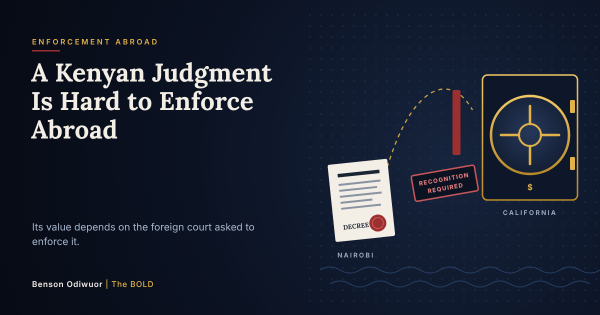
After years of litigation, a Kenyan claimant obtains judgment against a global technology company in the High Court in Nairobi. The court awards substantial damages and costs. The claimant's lawyers then turn to enforcement and discover the problem that should have been considered on the first day of the case: the company has no bank accounts, no property and no assets of any kind in Kenya. Everything it owns is in California, Dublin or Delaware, and the courts there will decide for themselves whether a Kenyan judgment deserves to be enforced.
Jurisdiction decides whether a Kenyan court can hear a case. Enforcement decides whether its judgment is worth anything. For claims against foreign platforms, the second question is often harder than the first, and the answer may depend on choices made long before judgment, including how the defendant was served and whether it chose to appear.
Where the assets are
Global technology companies typically hold their principal assets in the United States or in European hubs such as Ireland. Where they operate a Kenyan subsidiary, that subsidiary is a separate legal person, and a judgment against the foreign parent cannot ordinarily be enforced against the subsidiary's assets. A Kenyan judgment against the parent must therefore usually be taken abroad and enforced under the law of the country where the parent's assets are found.
That country is under no obligation to enforce it. Each legal system has its own rules for recognising foreign judgments, and those rules commonly ask whether the foreign court had jurisdiction over the defendant according to the enforcing country's own standards, not according to the foreign court's.
The United States
In the United States, recognition of foreign judgments rests on the principle of comity, which the Supreme Court described in Hilton v Guyot as neither a matter of absolute obligation nor of mere courtesy, but a recognition that one nation allows within its territory to the judicial acts of another.1 Most states, including California, have adopted legislation based on the Uniform Foreign-Country Money Judgments Recognition Act. Under the California statute, a court must refuse to recognise a foreign money judgment if the foreign court did not have personal jurisdiction over the defendant, and may refuse to recognise it if, among other grounds, the defendant did not receive notice of the proceedings in time to defend, or the judgment or the claim on which it is based is repugnant to the public policy of California or of the United States.2
For defamation claims, federal law imposes further hurdles. A United States court may not recognise a foreign defamation judgment unless the law applied by the foreign court provided at least as much protection for freedom of speech as the First Amendment, or the defendant would have been found liable under American law in any event. The foreign court's exercise of jurisdiction must also have complied with American standards of due process. Most significantly for platforms, a foreign defamation judgment against the provider of an interactive computer service will not be recognised unless it is consistent with the immunity that American law grants to online intermediaries for content posted by their users.3 In practice, a Kenyan defamation judgment against an American platform for content posted by its users is very unlikely to be enforced in the United States.
England
The position in England offers a more direct route for Kenyan judgments, but with a critical condition. Kenya is among the countries whose superior court judgments may be registered in England under Part II of the Administration of Justice Act 1920.4 Registration is not available, however, where the judgment debtor was neither carrying on business nor ordinarily resident within the jurisdiction of the original court and did not voluntarily appear or otherwise submit to that court's jurisdiction.5
The English common law applies the same principle to judgments from countries outside any statutory scheme. In Adams v Cape Industries plc, the Court of Appeal held that a foreign judgment will be enforced against a defendant only if the defendant was present in the foreign country when proceedings began or submitted to the foreign court's jurisdiction.6 The UK Supreme Court reaffirmed that rule in Rubin v Eurofinance SA, declining to create a more flexible test.7
The paradox of staying away
These rules create a paradox for foreign platforms sued in Kenya. Earlier articles in this series explained that a foreign defendant which takes part in Kenyan proceedings without protest risks being treated as having submitted to the Kenyan court's jurisdiction. That same submission may later allow the claimant to enforce the Kenyan judgment in England or elsewhere. A defendant that never appears in Kenya, by contrast, may lose the Kenyan case by default but leave the claimant with a judgment that the English courts will not register.
The paradox is softened in England by a statutory protection: a person is not treated as having submitted to a foreign court merely because it appeared to contest the court's jurisdiction or to ask the court to stay the proceedings in favour of another forum.8 A foreign defendant can therefore challenge jurisdiction in Kenya without necessarily exposing itself to enforcement in England, provided it confines itself to that challenge. Once it defends on the merits, however, the protection may be lost.
Reciprocity in reverse
The same principles operate when foreign judgments are brought to Kenya. The Foreign Judgments (Reciprocal Enforcement) Act provides for the registration of judgments from designated reciprocating countries, which currently include the United Kingdom, Australia, Rwanda, Tanzania, Uganda, Malawi, Zambia and Seychelles.9 The Court of Appeal has considered the registration of an English judgment under that Act, and the limits on setting such a registration aside.10 The Supreme Court has held that orders of foreign courts are not automatically enforceable in Kenya but require recognition by Kenyan courts,11 and has criticised foreign courts that disregard the orders of Kenyan courts and the sovereignty of the Kenyan legal system over its own nationals.12 Kenyan courts insist on scrutinising foreign judgments before giving them effect. Foreign courts will do the same to Kenyan ones.
Remedies that do not depend on foreign courts
Not every useful remedy requires enforcement abroad. Many claims against platforms seek something other than money: the removal of content, the deletion of data, the reinstatement of an account or a declaration that rights have been violated. Platforms frequently comply with such orders voluntarily, because they wish to continue operating in Kenya and to maintain good relations with Kenyan regulators. In the Worldcoin case, the High Court ordered companies incorporated in the United States, Germany, the Cayman Islands and the British Virgin Islands to delete biometric data collected from Kenyans within seven days, under the supervision of the Data Commissioner. The effectiveness of an order of that kind depends less on foreign recognition than on the defendant's interest in continuing to do business in Kenya.13
Money judgments may also be enforceable within Kenya in some cases. A foreign company with no assets in Kenya may nonetheless be owed money by Kenyan businesses, such as advertising revenue collected through local partners or payment intermediaries, and the Civil Procedure Rules allow a judgment creditor to attach debts owed to a judgment debtor by a third party within the jurisdiction.14 Whether such debts exist, and whether they are owed to the defendant itself rather than to a separate affiliate, will depend on how the company has structured its Kenyan operations.
Planning enforcement from the first day
For claimants, the lesson is that enforcement must shape strategy from the outset. Before filing, a claimant should identify where the defendant's assets are, which country's courts would need to recognise a Kenyan judgment, and what those courts will require. That analysis may affect the choice of remedy, the framing of the claim, the evidence gathered on jurisdiction, and even the decision whether to sue in Kenya at all rather than in the defendant's home courts. Where the realistic goal is removal of content or deletion of data, a declaration and injunction may achieve more than a damages award that cannot be collected.
For foreign platforms, the lesson is that the decision whether and how to participate in Kenyan proceedings has consequences well beyond Kenya. A carefully confined challenge to jurisdiction may protect the company from enforcement abroad. A full defence on the merits may not.
A judgment is a promise from the court. Whether that promise is kept often depends on courts in another country.
Benson Odiwuor is a Nairobi-based dispute resolution lawyer and researcher in internet jurisdiction, who handles dispute resolution in cross-border digital, data protection and online reputation matters. He is also the editor of The BOLD, a legal newsletter focusing on dispute strategies and legal developments in the regulated industries of Kenya. Subscribe to The BOLD here.
For inquiries, contact the author at nfo@bensonodiwuor.com.
References
- Hilton v Guyot 159 US 113 (1895) 163–64. ↩
- Cal Code Civ Proc §§ 1713–1725. ↩
- 28 USC §§ 4101–4105. ↩
- Reciprocal Enforcement of Judgments (Administration of Justice Act 1920, Part II) (Consolidation) Order 1984, SI 1984/129, sch 1. ↩
- Administration of Justice Act 1920, s 9(2)(b). ↩
- Adams v Cape Industries plc [1990] Ch 433 (CA). ↩
- Rubin v Eurofinance SA [2012] UKSC 46, [2013] 1 AC 236. ↩
- Civil Jurisdiction and Judgments Act 1982, s 33(1). ↩
- Foreign Judgments (Reciprocal Enforcement) Act (Cap 43); Foreign Judgments (Reciprocal Enforcement) (Extension of Act) Order, LN 135/1984. ↩
- Dari Ltd & 5 others v East African Development Bank (Civil Appeal 70 of 2020) [2023] KECA 454 (KLR). ↩
- Ingang'a & 6 others v James Finlay (Kenya) Ltd (Petition 7 (E009) of 2021) [2023] KESC 22 (KLR). ↩
- MAK v RMAA & 4 others (Petition 2 (E003) of 2022) [2023] KESC 21 (KLR), paras 49–51 and 56–58. ↩
- Republic v Tools for Humanity Corporation (US) & 8 others; Katiba Institute & 4 others (Ex parte Applicants); Data Privacy & Governance Society of Kenya (Interested Party) (Judicial Review Application E119 of 2023) [2025] KEHC 5629 (KLR). ↩
- Civil Procedure Rules 2010, Order 23. ↩